
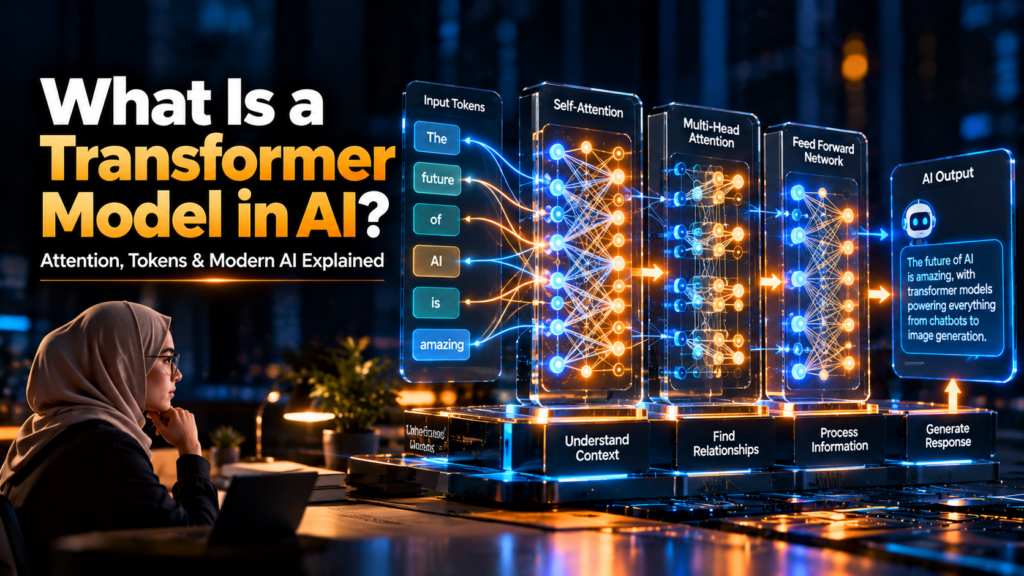
A transformer is a neural-network architecture that uses attention mechanisms to process relationships between parts of an input, such as words or tokens in a sentence. Transformers are central to many modern AI systems, including large language models, text translation systems, and some image, audio, and multimodal models. Attention helps a model weigh which parts of the available context are most relevant when processing a particular token.
In simple terms, a transformer turns input into numerical representations, uses attention and other neural-network layers to process context, and produces a representation or output for its task. Different transformer designs are used for different purposes: some focus on understanding text, some generate text one token at a time, and others map one sequence to another.
This beginner-friendly guide explains what a transformer model is, how attention works, what the main building blocks do, why transformers became important, and what their limitations are—without requiring advanced mathematics.
If you are building your AI fundamentals, start with our guides to artificial intelligence, how AI works, neural networks, and deep learning.
What is a transformer model in AI?
A transformer is a type of deep-learning architecture designed to process sequences or structured inputs using attention. In language tasks, the input is usually converted into tokens, and each token is represented numerically. Transformer layers use attention to model relationships between tokens, then apply additional neural-network operations to build representations useful for a task.
The architecture became widely influential after the 2017 research paper “Attention Is All You Need” introduced a sequence-processing model based on attention mechanisms rather than recurrence or convolution as the core sequence operation. The authors demonstrated it on machine-translation tasks and highlighted advantages in parallelising training. The paper is a landmark in the development of modern transformer-based AI, but it was a technical research contribution—not proof that every transformer is best for every task.
Today, transformers are used in many language models and increasingly in vision, audio, and multimodal applications. They are an architecture, not a complete product by themselves. A user-facing assistant may combine a transformer model with safety systems, retrieval, search, tools, a user interface, and other software components.
How do transformers work in plain English?
Imagine reading the sentence, “The dog chased the ball because it was excited.” To interpret “it,” a language system needs to connect that word with relevant information elsewhere in the sentence. Attention provides a mechanism for weighing relationships between tokens, including tokens that are not right next to one another.
A simplified transformer workflow looks like this:
- Split the input into tokens: text is converted into units such as whole words, parts of words, or punctuation, depending on the tokenizer.
- Represent tokens as numbers: each token receives a numerical representation called an embedding, which a neural network can process.
- Add information about order or position: the model needs a way to distinguish token positions, because word order affects meaning.
- Use attention: the network calculates how strongly different tokens should influence the representation being processed.
- Apply feed-forward layers and repeat: additional neural-network operations transform the representations through multiple layers.
- Produce the task output: depending on the architecture, the system may classify text, build representations, translate a sequence, or generate the next token.
This is a teaching overview, not a full implementation specification. Transformer architectures vary, and modern systems may add normalisation, residual connections, masking, caching, routing, or other mechanisms. The original paper provides the technical description: Attention Is All You Need.
What is attention in a transformer?
Attention is a mechanism that lets a model weigh information from different parts of its input when building a representation. Rather than treating every token as equally relevant to every other token, the model computes relevance weights from learned representations. These weights help it combine information from context.
Think of reading a paragraph and focusing on the words that clarify a pronoun, a name, or an idea. Human attention and machine attention are not the same, but this analogy helps explain the basic purpose: relevant context can influence how a token is represented.
In self-attention, tokens in the same input sequence can be used to calculate relationships with one another. In a language model that generates text from left to right, a causal mask prevents a position from using future tokens that have not yet been generated. Other transformer designs use different attention patterns depending on their task.
What is self-attention?
Self-attention is the operation through which a sequence can weigh information from other positions in that sequence. The model derives three learned projections commonly called queries, keys, and values:
- Query: represents what a token is looking for in the context.
- Key: represents information a token makes available for comparison.
- Value: carries information that can contribute to the combined output.
The analogy is only a guide; these are learned vectors, not literal questions or words that the model understands as a person would. A similarity calculation between queries and keys produces attention weights, which are then used to combine value information. This lets a token’s representation incorporate useful context from other positions.
What is multi-head attention?
Multi-head attention runs attention through several learned projections, often called heads. Each head can learn to represent different relationships or patterns, and their outputs are combined. In practice, heads do not always correspond to simple human-readable roles, and interpreting an individual head can be difficult.
Using multiple heads lets the model process different relationship patterns in parallel within a layer. It is one of the architectural ideas described in the original transformer paper. Multi-head attention is a design component, not a guarantee of accuracy or a sign that a model understands all the relationships it represents.
Transformer models explained visually
The infographic below summarises the main building blocks, a simplified path from tokens to output, common transformer variants, and some practical limitations. The same core ideas can be arranged differently across models.
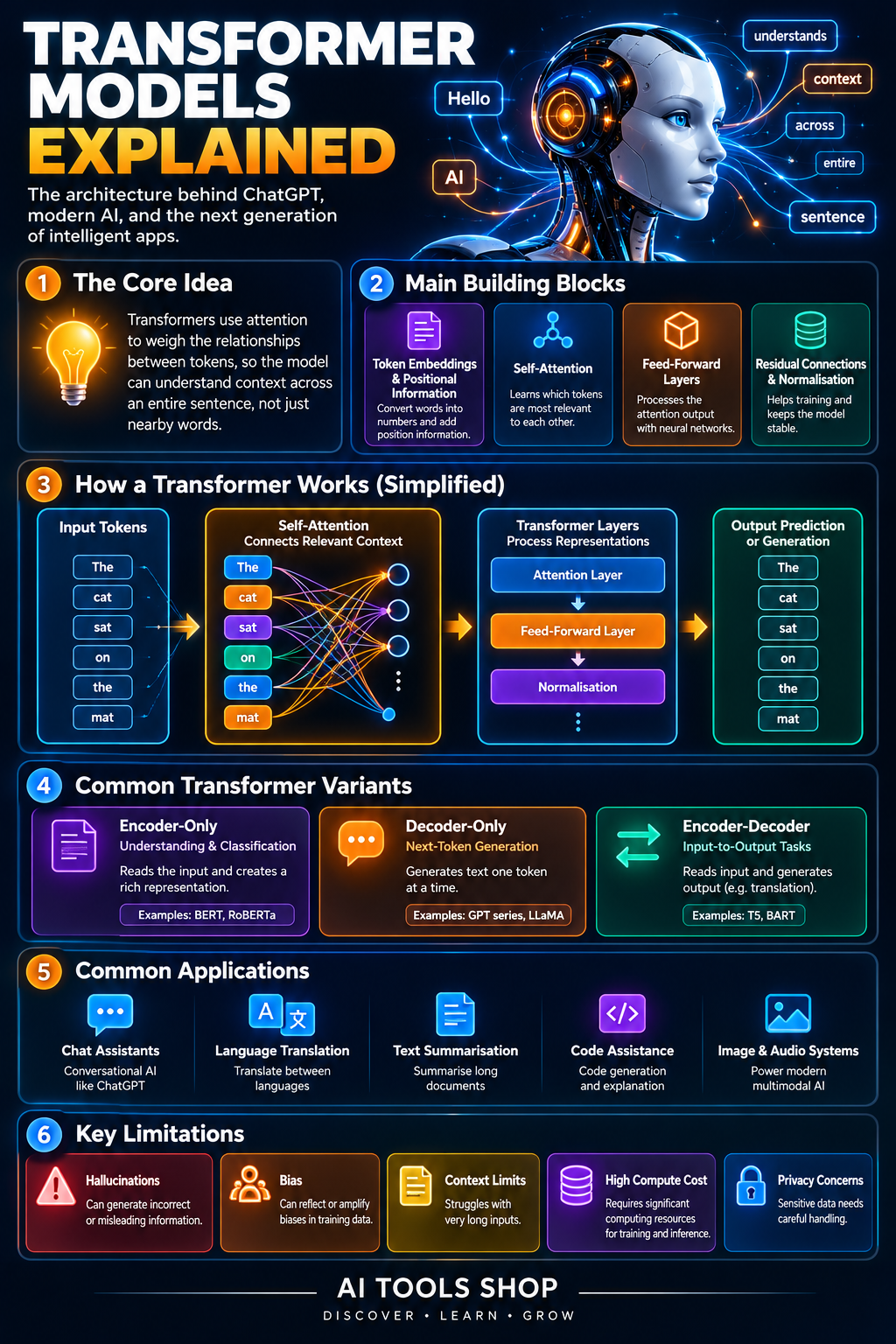
What are the main building blocks of a transformer?
Token embeddings
Before the model can process language, tokens are mapped to numerical vectors called embeddings. These vectors provide a representation the network can transform. A token embedding alone does not carry every detail needed for a task; its representation changes as it passes through transformer layers and interacts with context.
Positional information
Attention mechanisms do not automatically encode sequence order in the way word order matters in a sentence. Transformer designs therefore include positional information, using methods that vary by architecture. Position helps a model distinguish sequences such as “the cat chased the dog” and “the dog chased the cat,” which contain many of the same tokens but different meanings.
Self-attention layers
Self-attention lets each position combine information from relevant positions according to learned weights and the attention pattern allowed by the model. Some models can attend across a full input sequence, while autoregressive language models commonly mask future positions during generation or training.
Feed-forward networks
After attention, transformer layers usually apply a feed-forward neural network independently to each position’s representation. This transforms the information that attention has combined. Attention and feed-forward components are commonly stacked across multiple layers to build more complex representations.
Residual connections and normalisation
Many transformer designs include residual connections and normalisation operations. These help information and gradients flow through the network during training and can make deeper models easier to optimise. The precise order and implementation differ among architectures.
What are encoder-only, decoder-only, and encoder-decoder transformers?
Transformers are not all built for the same job. Three common design patterns are often used to explain the family of architectures.
| Architecture pattern | Primary use | Typical behaviour |
|---|---|---|
| Encoder-only | Understanding or representing input | Processes input tokens to build contextual representations; often used for classification, retrieval, and information extraction. |
| Decoder-only | Autoregressive generation | Predicts a next token from previous context and can continue generating a sequence; many modern chat-oriented LLMs use this pattern. |
| Encoder-decoder | Transforming one sequence into another | An encoder represents the input and a decoder generates an output, as in many sequence-to-sequence tasks. |
These are broad patterns rather than a complete taxonomy. Actual models can incorporate additional components, and the best architecture depends on the intended task. The Hugging Face course offers accessible lessons on transformers and language models, including how model families are used for different NLP tasks.
Why are transformers important for modern AI?
Transformers helped make it practical to train large sequence models with attention-based architectures and more parallelism during training than earlier recurrent approaches. They also provide a flexible design that has been adapted for language, vision, audio, and multimodal problems.
- Language models: process context and generate text for writing, question answering, summarisation, and code assistance.
- Translation: transform a sequence in one language into a sequence in another.
- Document analysis: represent and classify text, extract information, or support search and retrieval.
- Computer vision: some vision transformers process image patches or other visual representations.
- Audio and multimodal AI: transformer architectures can be adapted to audio or to systems that combine text, images, and other modalities.
Transformer models are an important part of the current AI ecosystem, but they are not the only useful architecture. Convolutional neural networks, recurrent networks, state-space models, retrieval systems, rules, and other techniques continue to have uses depending on the task and requirements.
Explore related explainers on large language models, generative AI, natural language processing, and computer vision.
How is a transformer different from older sequence models?
Earlier sequence models often used recurrent neural networks, which process tokens step by step, or convolution-based methods that apply filters across local regions. The transformer introduced an approach built around attention, allowing many token representations to be processed in parallel during training, subject to the architecture and computation used.
That parallelism can make training more efficient for certain workloads. However, it does not mean every transformer operation is parallel in every setting: autoregressive text generation normally produces tokens sequentially, and long contexts can still be computationally expensive. Performance depends on model design, sequence length, hardware, and implementation.
What are the limitations of transformer models?
Transformers are powerful, but they bring trade-offs and failure modes. Understanding these limits is part of using them responsibly.
- Hallucinations and incorrect output: a language model may generate plausible text that is inaccurate or unsupported.
- Context-window limits: a model can only process a bounded amount of information in a request, even when the product offers methods to retrieve or summarise larger collections.
- Compute and memory costs: training and running large models can require substantial hardware and energy. Attention over long sequences can be expensive, though implementations and architectures vary.
- Bias and uneven performance: the data, objectives, and deployment conditions can cause outputs to vary across topics, languages, or groups.
- Weakness outside tested conditions: performance on common examples does not guarantee robustness to unfamiliar inputs or adversarial prompts.
- Limited transparency: a complex model’s internal representations can be difficult to interpret fully.
- Privacy and security: applications must handle prompts, files, model access, and connected tools with appropriate controls.
For practical use, verify important claims, test generated code, protect private information, and do not rely on a model alone for high-impact decisions. Our guide to AI hallucinations and how to avoid them explains useful fact-checking habits.
How can you learn more about transformer models?
You can build understanding in stages without starting with equations.
- Learn the background: understand neural networks, tokens, embeddings, and the difference between training and inference.
- Understand attention conceptually: explore how token relationships help a representation use surrounding context.
- Compare model types: learn the difference between encoder-only, decoder-only, and encoder-decoder architectures.
- Read an accessible tutorial: the Hugging Face NLP course introduces transformer-based models and their use.
- Explore the original paper: read Attention Is All You Need for the original architecture and experiments.
- Evaluate outputs critically: when using a transformer-powered tool, test its answers and check sources instead of assuming fluency equals accuracy.
Frequently asked questions about transformer models
What is a transformer model in one sentence?
A transformer is a neural-network architecture that uses attention mechanisms to process relationships between parts of an input, such as tokens in text.
Is ChatGPT based on transformers?
ChatGPT is a product that uses OpenAI models. OpenAI’s language models have used transformer-based architectures, but the product can also include other software components and tools; specific model implementations differ.
What is the difference between a transformer and an LLM?
A transformer is a model architecture. A large language model (LLM) is a model trained to process and generate language at large scale. Many modern LLMs use transformer architectures, but the terms do not mean the same thing.
What is attention in AI?
Attention is a mechanism that calculates how strongly different parts of an input should contribute to a representation. In transformers, self-attention helps model relationships between tokens and their context.
Why are transformers good for language?
Attention lets a model combine information from different positions in a sequence, and transformer layers can be trained efficiently in parallel across input positions for many tasks. These properties have made transformers effective for many language applications, though results depend on training, architecture, and evaluation.
Do all transformer models generate text?
No. Some are designed mainly to represent or classify inputs, while others generate sequences. Encoder-only, decoder-only, and encoder-decoder models are common patterns with different purposes.
Are transformers always better than other neural networks?
No. Transformers are versatile, but they may be costly or unnecessary for some tasks. Other architectures and simpler methods can be more suitable depending on the data, latency, hardware, accuracy, and interpretability requirements.
Final thoughts
Transformer models use attention to process relationships between tokens and context. Their flexible architecture helped shape many modern language models and has also been adapted for image, audio, and multimodal AI. The key ideas are tokens, attention, multiple processing layers, and an output suited to a specific task.
Transformers are not magic, and they are not automatically accurate. Their results depend on training data, model design, available context, evaluation, and the way a product is used. Keep learning with AI Tools Shop’s guides to LLMs, deep learning, and generative AI.
Official sources and further reading
- Vaswani et al. (2017): Attention Is All You Need
- Google Research: Attention Is All You Need
- Hugging Face: NLP Course and transformer introduction
- Google for Developers: Machine Learning Glossary
Related concept: Transformer models process text as tokens. Read our guide to AI tokens and tokenization to understand how text is split into model-readable units and how token counts affect context limits.
Editorial note: This article describes transformer concepts at a beginner level. Architecture and implementation vary by model, and the explanation does not claim that every modern AI product uses the same design or that any product was independently benchmarked.