
AI hallucinations are incorrect, misleading, or unsupported claims generated by an AI system—sometimes presented with confident, convincing language. Examples include invented facts, fake citations, incorrect dates, made-up quotations, or summaries that add details not found in the source.
You can reduce the risk of AI hallucinations by giving the model clear instructions and reliable source material, asking it to show where important claims come from, checking cited sources directly, and independently verifying high-impact facts. However, no prompt or single technique can guarantee that every AI answer is true or eliminate hallucinations completely.
This guide explains what AI hallucinations are, why they happen, how to recognise them, and practical methods individuals and businesses can use to reduce errors. It draws on official guidance from OpenAI, Google Cloud, NIST, and Microsoft Learn.
For background, you may also find our guides to generative AI, large language models (LLMs), and how AI works useful.
Table of Contents
What Are AI Hallucinations?
An AI hallucination happens when an AI system produces information that is false, unsupported, inconsistent with the supplied source, or otherwise misleading. The term is commonly used for generative AI systems, especially language models, that produce plausible-sounding statements without a reliable factual basis.
OpenAI describes hallucinations as cases where a language model confidently generates an answer that is not true. They can include inaccurate facts, fabricated quotations, and references to sources that do not exist. Google Cloud similarly describes hallucinations as incorrect or misleading results that an AI model generates. See OpenAI’s explanation of why language models hallucinate and Google Cloud’s guide to AI hallucinations.
A hallucination is not always an obviously strange answer. Often, the output is fluent, detailed, and confidently worded, which can make it harder to notice the error. That is why a polished writing style should not be treated as proof that a claim is accurate.
What Do AI Hallucinations Look Like?
Hallucinations can appear in many different tasks, from casual writing to factual research. Here are common examples:
| Type | Example | How to check it |
|---|---|---|
| Invented fact | An AI states a date, statistic, or event that is not true. | Check an authoritative source that directly supports the claim. |
| Fake citation | A response names a paper, author, report, or URL that does not exist. | Open the source; confirm the title, author, date, and relevant passage. |
| Unsupported detail | A summary adds a claim that was not in the document supplied. | Compare the summary with the original text. |
| Incorrect quotation | A response puts words in quotation marks and attributes them to a person who did not say them. | Find the quotation in a transcript, recording, publication, or reliable archive. |
| Wrong calculation | A model gives an arithmetic answer that contains an error. | Recalculate with a calculator, spreadsheet, or verified code. |
| Inconsistent answer | The system gives conflicting figures or explanations in the same response or across attempts. | Check each claim independently and identify the authoritative source. |
For example, an AI might draft a company biography and invent a founder’s award, or summarise a report while adding a percentage that never appeared in it. The fact that the surrounding paragraph reads naturally does not validate the made-up detail.
Why Do AI Hallucinations Happen?
There is no single cause. Hallucinations can result from limits in training data, missing context, ambiguity, model limitations, weak grounding in verified sources, or a system that produces an answer even when the available evidence is insufficient.
1. Language models generate likely continuations, not guaranteed facts
Many language models generate text by predicting tokens based on patterns learned during training and the context they receive. This can produce useful, accurate answers, but the process does not guarantee that every generated claim is true. A sentence may sound like a familiar factual pattern while still containing an incorrect detail.
2. The model may lack the required information
A model may not have access to a recent event, a private document, an obscure fact, or the source needed to answer the question. If it still produces a specific response, it may fill the gap with a plausible guess. Asking for information it cannot access does not make that information available.
3. Prompts may be ambiguous
A broad request can leave the model guessing about the intended meaning, date range, audience, or evidence standard. For example, “What is the latest policy?” is incomplete unless the jurisdiction, organisation, topic, and date are clear.
4. Context or source material may be incomplete
If a document is missing a page, the relevant passage is not provided, or a search system retrieves irrelevant material, the answer may be incomplete or unsupported. Even when a model is given sources, it can misinterpret them or draw conclusions the sources do not establish.
5. Fluent answers can hide uncertainty
AI systems can express a claim confidently despite being wrong. OpenAI’s 2025 discussion of hallucinations notes that evaluation approaches that reward correct answers without appropriately rewarding calibrated uncertainty can encourage guessing instead of saying “I don’t know.” This is one reason users should check evidence rather than infer reliability from confidence or detail.
For a deeper explanation, read the official OpenAI research summary on language-model hallucinations and the NIST Generative AI Risk Management Framework Profile, which uses the term “confabulation” for outputs that are confidently presented but erroneous or false.
How Can You Spot an AI Hallucination?
You usually cannot identify every hallucination from wording alone, so use a verification process. Pay particular attention to precise claims that can be checked independently.
- Verify specific dates and numbers: look for an official data source or primary document.
- Open every important citation: confirm that the source exists and actually supports the sentence attached to it.
- Look for unsupported precision: exact percentages, quotations, rankings, and timelines need evidence.
- Compare with supplied material: for a summary or extraction task, make sure each claimed fact appears in the source.
- Watch for internal contradictions: check whether different sections state conflicting details.
- Ask what is unknown: request that the system distinguish verified facts, assumptions, and unresolved questions.
- Use independent checks: calculations, code, legal references, and technical claims may need specialist tools or qualified review.
A citation is useful only if it is real, relevant, and accurately represented. A list of impressive-looking sources is not enough; visit the links and inspect the evidence yourself.
How Can You Reduce AI Hallucinations?
You can reduce the risk, but you cannot guarantee that hallucinations will never occur. A strong workflow combines clear prompts, reliable context, source-grounded answers, direct verification, and appropriate human review.
1. Give the model a clear, bounded task
Specify the question, intended audience, scope, date or region when relevant, and the format you need. If the answer must be based on supplied material, say so explicitly. Avoid mixing unrelated tasks or conflicting requirements.
2. Provide reliable source material
For research, policy, product, or document questions, supply the relevant documents or direct the model to trusted sources that it can actually access. Tell it to use the provided context for factual claims and to say when the context does not contain the answer.
3. Ask for citations near factual claims
Request a link or reference for each important factual statement, not just a bibliography at the end. Then open the links and confirm the source supports the claim. Citation instructions can help make answers easier to verify, but they do not prevent fake or irrelevant citations by themselves.
4. Tell the model to acknowledge uncertainty
Explicitly permit an answer such as “I can’t verify this from the available information.” This can discourage unsupported guessing. However, the model may still express uncertainty incorrectly or make a claim it cannot substantiate, so independent checking remains necessary.
5. Use retrieval or grounding where appropriate
For repeatable applications, retrieval-augmented generation (RAG) or other grounding methods can provide relevant passages from approved documents or search results. The model can then base its answer on that material and cite it. Grounding can reduce unsupported answers, but retrieval may miss relevant passages, sources may be wrong or outdated, and the model may still misread the evidence.
6. Check numbers with the right tools
For arithmetic, data analysis, and code, use a calculator, spreadsheet, code execution, or a validated software function when available. Language-model output should not replace a calculation or program that can be independently checked.
7. Break complex tasks into verifiable steps
For a long report, ask the model to extract evidence first, create a claim list, and draft only after the evidence is checked. This makes unsupported additions easier to catch. Do not add unnecessary steps to a simple task; the aim is better verification, not more process for its own sake.
8. Test recurring workflows
If AI is used regularly for customer support, research, content production, or internal operations, create test cases that include tricky questions and situations where the correct answer should be “not enough information.” Track incorrect claims, unsupported citations, and omissions over time. Re-test after changes to the prompt, source material, or model.
Microsoft Learn recommends explicit grounding instructions, fallback behaviour when the context is insufficient, and citations to supporting source material in its RAG prompt-engineering guidance. Google Cloud also describes grounding and relevant source data as useful ways to reduce hallucinations in its hallucination overview.
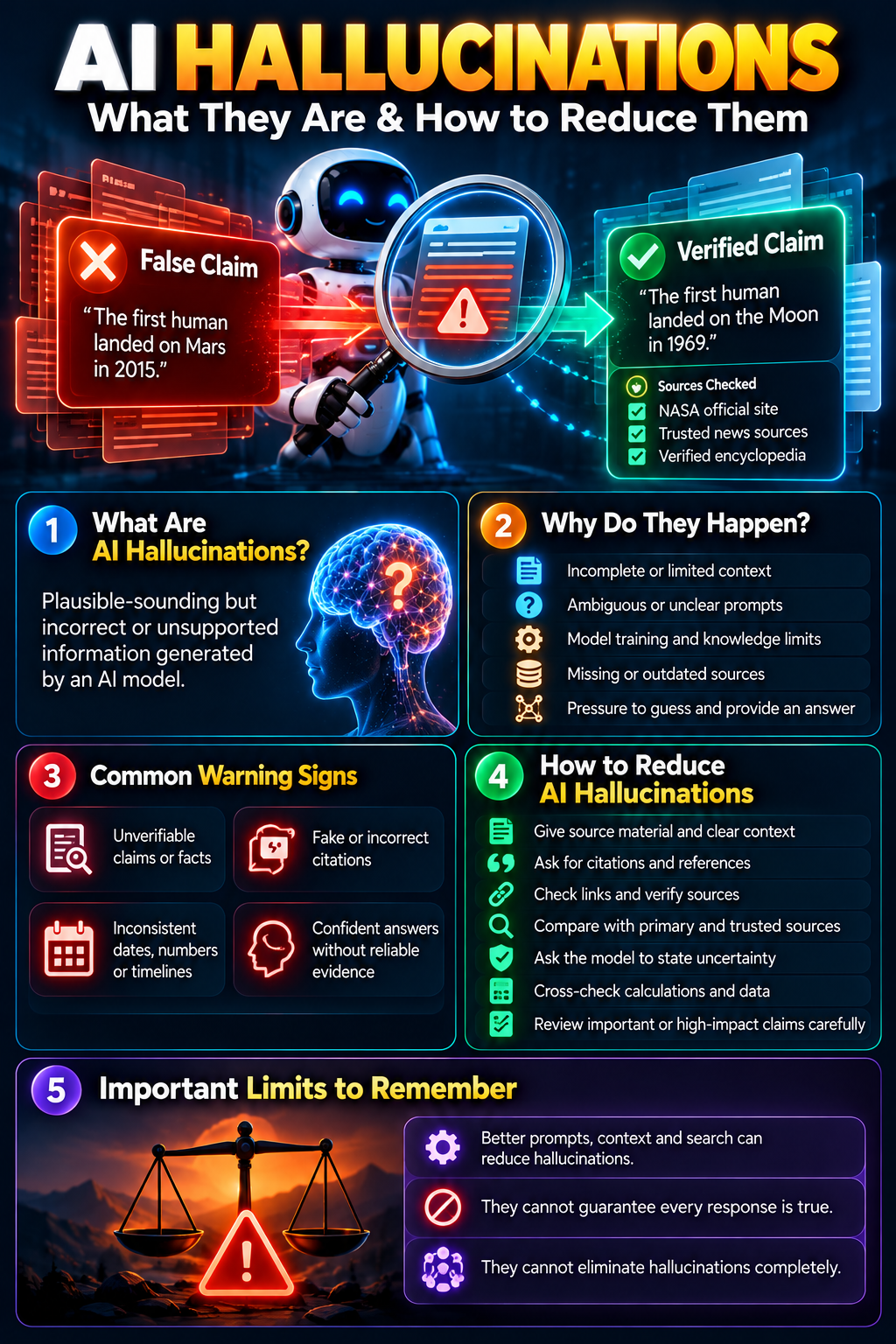
AI Hallucinations: A Visual Checklist
Use this infographic as a quick reminder of common warning signs and practical ways to reduce risk. The key message is that verification is part of using AI responsibly—not an optional final step.
What Prompt Can You Use to Reduce Hallucinations?
The following prompt encourages source discipline and uncertainty. It is a helpful starting point, not a technical safeguard and not a guarantee that the answer will be correct.
Answer this question: [insert question]

Requirements:
1. Use the source material or trusted references provided.
2. For important factual claims, include a direct citation or source link.
3. Do not invent figures, quotes, events, or references.
4. If the available evidence is insufficient, say what is missing.
5. Separate verified information from assumptions or interpretation.
6. Flag details that need independent verification.
7. Before finishing, check that each citation supports the claim it accompanies.

Question context:
[audience, date range, region, or other relevant details]

Source material:
[paste text or list accessible source links]
After receiving the answer, open each citation and check the source itself. Asking for verification is useful, but the model’s own statement that it has verified something is not proof that the verification was successful.
How Can Businesses Reduce AI Hallucinations?
Organisations need more than a better prompt when AI is connected to customer data, internal documents, or business systems. A reliable process usually combines evidence, access controls, testing, and human accountability.
| Control | What it does | Example |
|---|---|---|
| Approved knowledge sources | Limits factual answers to relevant, maintained content where possible. | Use a current product manual or internal policy repository. |
| Grounding and citations | Connects claims to source passages or retrieved documents. | Require an answer to cite the policy section it relies on. |
| Fallback rules | Prevents the workflow from inventing an answer when evidence is missing. | Route unanswered policy questions to a human agent. |
| Automated evaluation | Tests accuracy, citation quality, completeness, and failure cases. | Run a regression set whenever a model or prompt changes. |
| Human review | Checks high-impact or uncertain outputs before action. | Require approval before sending legal, financial, or medical advice. |
| Monitoring and feedback | Identifies recurring errors and tracks changes after deployment. | Review incorrect responses and update the source material or workflow. |
For sensitive uses, organisations should document known limitations, protect confidential information, define who is accountable, and provide a way to report and correct mistakes. NIST’s Generative AI Profile provides a risk-management framework for considering reliability and other generative-AI risks.
What Does Not Reliably Prevent AI Hallucinations?
- “Just tell the AI to be 100% accurate.” A stronger instruction cannot guarantee correctness.
- Trusting confident language. Confidence and fluency do not prove that the response is supported.
- Accepting citations without opening them. References can be fabricated, irrelevant, or misrepresented.
- Assuming search or RAG fixes everything. A retrieved source can be incomplete, unreliable, or misunderstood.
- Repeatedly asking the same question until the answer sounds right. Repetition does not establish which answer is correct.
- Using AI to validate its own output without independent evidence. A second AI pass can help identify potential issues, but it can repeat the same errors.
Use AI to assist with checking, but whenever accuracy matters, the final check should be tied to evidence, a reproducible calculation, a trusted database, or a qualified person—not just another confident response.
When Is Human Review Essential?
Human review is especially important when an incorrect answer could affect health, safety, legal rights, finances, employment, security, or another consequential decision. In such cases, AI should be used within a process that has appropriate expertise, verification, and accountability.
For example, a model may help summarise a medical paper, but it should not be treated as a clinician. It may help find relevant legislation, but the text and current applicability should be confirmed. It can draft financial analysis, but the calculations, assumptions, and conclusions need independent review.
For lower-risk tasks such as brainstorming or drafting a casual message, a lighter review may be sufficient. The required level of verification should match the consequence of being wrong.
Frequently Asked Questions About AI Hallucinations
What is an AI hallucination in simple words?
An AI hallucination is an incorrect, misleading, or unsupported output from an AI system. It might be a made-up fact, a fake citation, an incorrect date, or a detail added to a summary that was not in the source.
Why do AI hallucinations happen?
They can happen because a model lacks relevant information, receives ambiguous instructions, relies on incomplete context, misinterprets sources, or generates a plausible continuation that is not factually grounded. Multiple causes can contribute to the same error.
Can AI hallucinations be prevented completely?
No current prompting or grounding method provides a universal guarantee that all hallucinations will be eliminated. Clear prompts, reliable sources, retrieval, evaluations, and human review can reduce risk, but outputs still need verification.
What is the best prompt to avoid AI hallucinations?
Ask the AI to use specified sources, cite important claims, avoid inventing facts or references, identify missing evidence, and state when it cannot verify something. Then check the cited sources directly; the prompt alone cannot guarantee accuracy.
Can AI invent citations or sources?
Yes. AI systems can produce plausible-looking titles, authors, quotations, or URLs that are incorrect or do not exist. Open the link and verify that the source is real and supports the claim.
Does web search stop hallucinations?
Web search can provide current sources and help ground an answer, but it does not eliminate errors. A system may retrieve unreliable material, miss relevant evidence, misread a page, or make claims that the sources do not support.
How can I check an AI-generated answer?
Identify its important factual claims, open the cited sources, compare numbers and quotations with primary references, recalculate figures using suitable tools, and check whether summaries stay faithful to the source. Use a qualified reviewer for high-impact topics.
How can a business reduce AI hallucinations?
Use maintained knowledge sources, grounding and citations, fallback rules for unanswered questions, representative evaluations, monitoring, and human review for consequential actions. Limit access to the data and tools necessary for the job.
Final Thoughts
AI hallucinations are plausible-sounding but incorrect or unsupported outputs. They can occur even when the model sounds confident, which makes verification essential for factual research, publishing, and important decisions.
The most useful protection is a repeatable process: define the question clearly, supply reliable context, ask for evidence, check sources independently, and escalate uncertain or high-impact claims to a qualified person. Prompting and grounding can make AI more useful, but neither should be mistaken for a guarantee of truth.
Keep exploring AI Tools Shop’s beginner guides to generative AI, large language models, agentic AI, and prompt engineering.
Official Sources and Further Reading
- OpenAI: Why Language Models Hallucinate
- OpenAI Help Center: Does ChatGPT Tell the Truth?
- Google Cloud: What Are AI Hallucinations?
- NIST: Artificial Intelligence Risk Management Framework — Generative AI Profile
- Microsoft Learn: RAG Prompt Engineering and Grounding
Editorial note: This article summarises public documentation and general risk-reduction practices. No method described here guarantees hallucination-free AI, and this article does not claim independent testing of specific models.