Most people have used a chatbot: you ask a question, and it replies. Agentic AI goes a step further. Depending on how it is designed and configured, an AI agent can work toward a goal by planning steps, choosing tools, taking permitted actions, checking results, and adjusting what it does next. Rather than only telling you how to complete a task, it may help carry out parts of the task for you.
For example, a basic support chatbot might explain a company’s refund policy. A more agentic customer-support system might look up an authorised order, check the policy, prepare a refund request, and ask for approval before taking a sensitive action. The exact capabilities depend on the software, permissions, integrations, and safety controls—it is not an unlimited or automatically reliable digital employee.
This guide explains what agentic AI means, how it differs from ordinary chatbots, how AI agents work, where they can be useful, and what risks to consider before giving them access to real systems. For background, start with our guides to artificial intelligence, how AI works, and large language models (LLMs).
What is agentic AI in simple words?
Agentic AI refers to AI systems designed to pursue a goal with some degree of autonomy. They can use a model—often a large language model—to interpret a task, decide which step or tool may be useful, observe the result, and continue or change course. The level of independence varies widely: one agent may follow a narrow workflow, while another may choose among tools over a longer task.
Google Cloud describes agentic AI as systems focused on decision-making and action, often using tools to carry out multi-step work. IBM similarly highlights autonomy, goal-directed behaviour, and the ability to use tools or connect to external systems. These descriptions are useful starting points, but “agentic AI” is an evolving term rather than one universally standardised technical specification.
Read the official explainers for context: Google Cloud: What is agentic AI? and IBM: What is agentic AI?.
What is the difference between agentic AI and a chatbot?
A chatbot is a conversational interface. It may answer questions, provide information, or follow a scripted dialogue. An AI agent is defined more by how it operates than by how it looks: it can be designed to pursue an objective through multiple steps and use tools to act on what it learns from the environment.
This is not a strict either-or distinction. A chatbot can be the interface to an agent, and a simple agent may have a chat window. The meaningful difference is the system’s capabilities, autonomy, permissions, and ability to take action—not whether users type messages into it.
| Feature | Basic chatbot | Agentic AI system |
|---|---|---|
| Typical purpose | Answer questions or respond in a conversation | Work toward a goal across multiple steps |
| Process | Often responds to one prompt or follows a scripted flow | May plan steps and adapt based on tool results |
| Tool use | May be limited to information retrieval or predefined integrations | May select and use authorised tools such as search, APIs, or software actions |
| Action | Usually provides a response or recommendation | Can execute permitted actions through connected systems |
| Human involvement | Person generally decides what to do next | Human checkpoints can be built in, especially for sensitive actions |
| Risk | Incorrect answers or misleading information | Incorrect answers plus possible unintended actions, data access, or cascading errors |
A modern chatbot can have memory, search, and tool access, so the categories overlap. The distinction is best understood as a spectrum of autonomy. Google Cloud’s guide to AI agents also compares agents with assistants and conventional bots.
How does agentic AI work?
Agentic systems vary in architecture, but a common pattern is a repeated loop: understand the goal, plan or select a next step, use a tool if needed, observe the result, and decide what to do next. The system may stop when it reaches a success condition, reaches a limit, or needs a person to intervene.
- 1. Receive a goal: the user states the result they want, such as researching a topic or sorting customer requests.
- 2. Build a plan: the system breaks the task into steps or decides which action to try first.
- 3. Select tools: it may use approved resources such as web search, a calendar, a database, a code runner, or a business API.
- 4. Take an action: it performs an allowed operation, such as searching, drafting, or creating a ticket.
- 5. Observe the result: the system reads the tool output or feedback and checks whether progress was made.
- 6. Continue, ask, or stop: it may choose another step, request missing information, ask a person to approve an action, or finish.
This loop is a simplified teaching model, not a requirement that every agent uses exactly these stages. In practice, an agent may use several models, fixed software rules, retrieval, memory, or a predefined workflow. Anthropic’s technical article Building effective AI agents distinguishes predefined workflows from agents that dynamically direct their own process and tool use.
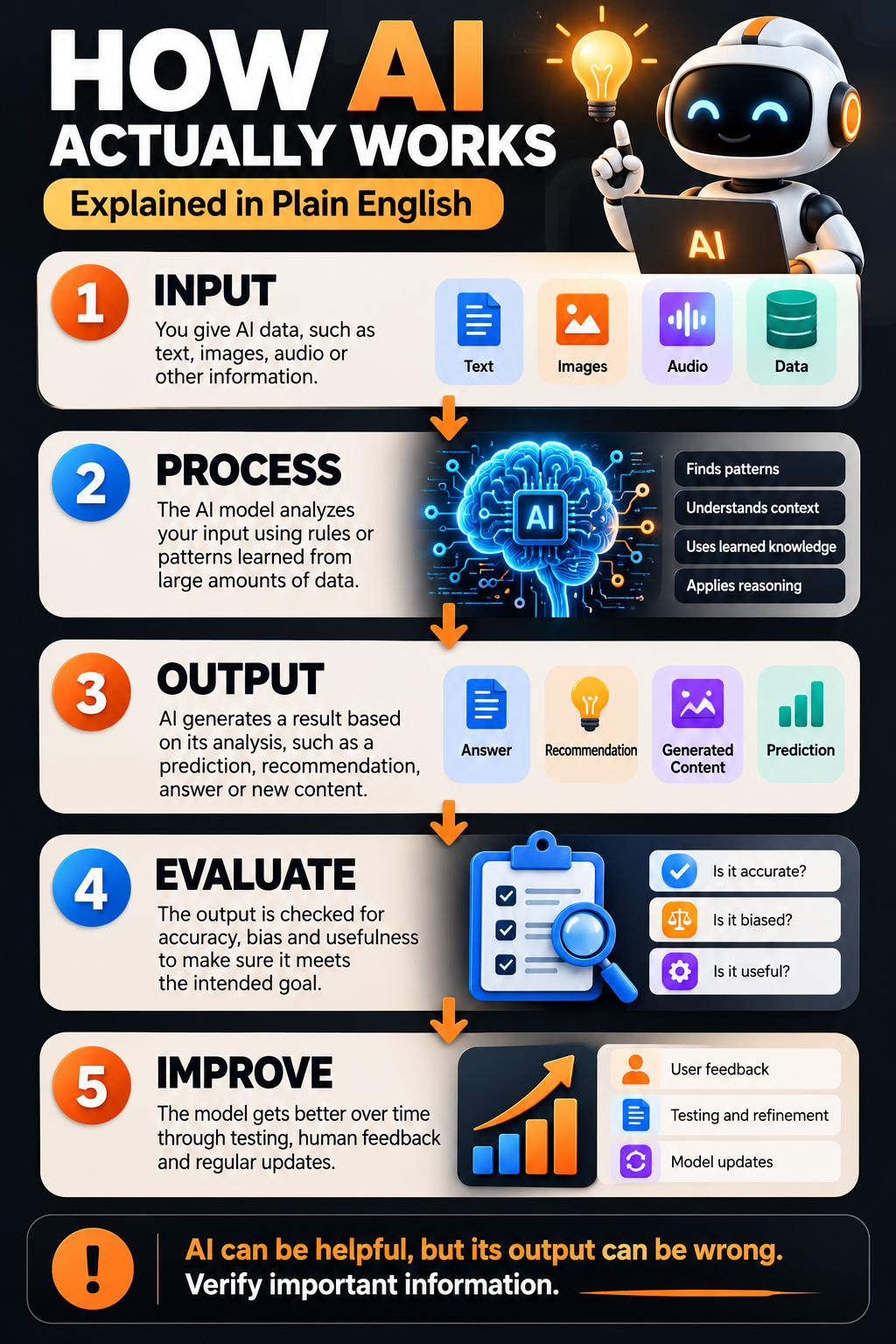
Agentic AI explained visually
The infographic below contrasts a prompt-and-response chatbot with an agentic system that can plan steps, use tools, observe the result, and request human approval when needed.
What are real-world examples of agentic AI?
Customer support
A basic chatbot may answer questions using a help centre. An agentic support system could search the knowledge base, retrieve an authorised ticket, summarise the issue, draft a response, and route the case to a team. If the system is permitted to update records or issue refunds, those actions should be tightly controlled and may require approval.
Research and reporting
An agent could search for information across approved sources, collect relevant passages, organise findings, identify gaps, and produce a draft report. The final report still needs source checking: the agent may misunderstand a page, rely on weak sources, or miss important context.
Software development
A coding agent may inspect a project, propose changes across files, run tests, analyse errors, and revise its solution. Automated tests can help catch mistakes, but they do not guarantee that the code is secure or meets the wider requirements. Human code review and restricted execution environments remain important.
Business operations
In a controlled workflow, an agent might classify incoming requests, gather information from approved systems, draft routine updates, and escalate exceptions. Businesses should define which actions the system may perform, which data it can access, and when it must stop and request a human decision.
Personal productivity
Depending on its integrations, a personal agent might help organise tasks, summarise documents, prepare a calendar plan, or compile information from multiple apps. Reading, drafting, and planning are lower-impact capabilities than sending messages, moving money, deleting files, or changing records. Those higher-impact actions deserve stronger safeguards.
What is the difference between agentic AI and generative AI?
Generative AI focuses on producing content—such as text, images, audio, video, or code—from prompts and learned patterns. Agentic AI focuses on pursuing a goal through decisions and actions, often using a generative model as part of the system. The two can work together: an agent may use a language model to plan, generate content, interpret tool results, or decide what step to attempt next.
| Aspect | Generative AI | Agentic AI |
|---|---|---|
| Primary emphasis | Generate content or a response | Achieve a goal through a sequence of steps |
| Typical result | Draft, image, summary, or code suggestion | Completed or progressed task, often involving tool results and outputs |
| Tool use | May be absent or limited to a single interaction | Often uses tools iteratively to gather information or act |
| Relationship | Can provide the model capability used by an agent | May combine generative AI with tools, rules, memory, and controls |
These terms are not mutually exclusive. Many agentic systems use generative models, while many generative AI tools simply create a response and do not independently execute a broader task. Learn more in our article What Is Generative AI?.
When should you use an AI agent instead of a chatbot?
An agent may be useful when a task involves multiple steps, changing information, authorised tools, and a result that can be checked. A simple chatbot or a fixed workflow may be better when the task is straightforward, predictable, or high-risk enough that human decision-making should remain central.
- Use a chatbot for: answering common questions, explaining policies, brainstorming, or producing a draft for a human to review.
- Use a fixed workflow for: repeatable tasks with a known sequence, such as validating a form and routing it to the correct queue.
- Consider an agent for: complex tasks where the exact steps depend on what the system discovers, such as research across multiple approved sources or investigating a software issue.
Anthropic recommends starting with the simplest solution that meets the need. A more autonomous system can introduce extra cost, latency, complexity, and a greater chance that errors compound across multiple steps. An agent is not automatically better just because it can take more actions.
What are the risks of agentic AI?
Because agents can interact with connected tools and systems, failures may have consequences beyond a wrong answer. Risk depends on what the agent can access, which actions it can perform, how it receives instructions, and how its behaviour is monitored.
- Tool misuse: an agent can choose an unsuitable tool or use it in an unexpected way.
- Excessive permissions: broad access can allow a mistake to affect more data or systems than necessary.
- Prompt injection: malicious instructions hidden in a webpage, document, or other input may try to redirect the system.
- Privacy and data exposure: an agent may access or transmit information through its connected tools if controls are weak.
- Cascading errors: one incorrect step can influence later decisions in a multi-step process.
- Unintended actions: sending, deleting, purchasing, or changing records without adequate review can create real consequences.
- Cost and reliability: repeated tool calls or loops can be slow, expensive, or fail to reach the goal.
OWASP’s work on agentic AI security highlights the need to manage agent identity, permissions, tools, memory, and communication. Its State of Agentic AI Security and Governance report provides broader context on securing and governing autonomous systems.
How can agentic AI be used more safely?
Safety should be part of the design, not something added after an agent has been given access to important systems. These practices are useful starting points for developers and organisations:
- Use least-privilege access: give the agent only the tools, data, and permissions required for its task.
- Require approval for consequential actions: ask a person before payments, external messages, deletions, permission changes, or other sensitive operations.
- Set stopping conditions: define time, step, budget, and retry limits so the agent cannot continue indefinitely.
- Keep logs and monitoring: record tool calls and important decisions so unexpected activity can be investigated.
- Test in a sandbox: evaluate failures and attacks in a controlled environment before enabling production access.
- Treat external content as untrusted: webpages and uploaded documents can contain instructions that should not automatically override the user’s goal or system policy.
- Provide a stop mechanism: people should be able to pause or revoke the agent’s access when something appears wrong.
- Measure results: test accuracy, completion, cost, reliability, and safety on representative tasks.
For a technical perspective, see Anthropic’s guidance on building effective agents and OWASP’s agentic AI security and governance resources. These sources stress the importance of simplicity, evaluation, tool design, and guardrails instead of adding autonomy without a clear reason.
Frequently asked questions about agentic AI
Is agentic AI the same as an AI chatbot?
No. A chatbot is a conversational interface and may simply respond to prompts. Agentic AI describes systems that can pursue a goal through multiple steps and use tools to take permitted actions. A chatbot can, however, serve as the interface to an agent.
Does agentic AI work without human supervision?
Not necessarily. Autonomy varies by system and task. Many agents need human direction, approval checkpoints, monitoring, or help with exceptions. High-impact actions should have safeguards appropriate to their consequences.
Can agentic AI use tools and websites?
It can if developers connect it to tools and grant the required permissions. Capabilities may include search, database queries, APIs, code execution, or application actions. Access should be restricted to what the task requires and monitored for unexpected behaviour.
Is agentic AI more powerful than generative AI?
They describe different emphases rather than a simple power ranking. Generative AI produces content; agentic systems use decision-making and action to work toward goals. An agent may use a generative model as one component, and the right design depends on the job.
What is an example of agentic AI at work?
A support agent might retrieve an authorised ticket, gather information from a knowledge base, draft a response, and route the case for approval. More complex agents may perform additional steps, but all actions depend on the integrations, permissions, and controls provided by the organisation.
Should every business use agentic AI?
No. A simple rule, chatbot, or fixed workflow may be cheaper and more reliable for predictable tasks. Consider an agent when the task genuinely requires flexible multi-step decisions and when the value justifies the cost, testing, and governance effort.
Final thoughts
Agentic AI is an approach in which AI systems can work toward a goal by planning steps, using approved tools, observing results, and deciding what to do next. A chatbot typically focuses on conversational responses, although the same chat interface can also provide access to an agent. The real distinction is the degree of autonomy and action the system has been designed and authorised to perform.
Agents can make useful multi-step tasks easier, but greater autonomy also creates additional risks. Start with a clear use case, give the system only necessary permissions, test it carefully, and keep people in control of consequential actions. Continue learning with our guides to AI basics, large language models, and generative AI.
Official sources and further reading
- Google Cloud: What is agentic AI?
- Google Cloud: What are AI agents?
- IBM: What is agentic AI?
- Anthropic: Building effective AI agents
- OWASP: State of Agentic AI Security and Governance
Editorial note: “Agentic AI” is an evolving term, and agent capabilities vary by design and permissions. This article explains general concepts and does not claim that a specific agent product was independently tested.