

Generative artificial intelligence (generative AI or GenAI) is a type of AI that creates new content—such as text, images, audio, video, and code—in response to prompts or other inputs. It has become widely discussed because people can now use conversational tools to draft an email, explore an idea, create a picture, summarise a document, or get help with code without needing to build an AI system themselves.
Generative AI is not magic and it is not a human mind. These systems learn patterns from data and use those patterns to produce outputs. The results can be impressive, but they can also be inaccurate, biased, outdated, or unsuitable. This guide explains what generative AI means, how it works in simple terms, what it can create, why it has attracted attention, and how to use it responsibly.
For the formal definition, the US National Institute of Standards and Technology describes generative AI as models that emulate the structure and characteristics of input data to generate derived synthetic content, including text, images, video, audio, and other digital content. See the NIST generative AI glossary entry.
What is generative AI in simple words?
Think of generative AI as software that can create a new response based on what it learned during training and the instructions you give it. You might ask a text tool to draft a product description, an image generator to create a landscape, or a coding assistant to suggest a function. The system uses a model to produce an output that fits the request and patterns it has learned.
“Generate” does not mean the system creates from a human-like imagination or understands the world exactly as a person does. It means the model produces an output by applying learned patterns and its design. Whether the result is factually correct, original in the legal sense, or fit for a particular use still needs evaluation.
If you are new to AI, first read our companion guides: What Is Artificial Intelligence? and How Does AI Actually Work?. They explain the broader field and the basic process behind AI systems.
What can generative AI create?
Generative AI can produce several kinds of content, depending on the model and the product built around it.
- Text: article outlines, explanations, emails, stories, product copy, summaries, and translations.
- Images: illustrations, concept art, backgrounds, thumbnails, mock-ups, and visual ideas.
- Audio: speech, voiceovers, sound effects, and music-like outputs.
- Video: short clips, animations, scenes, and other video content in supported tools.
- Code: code suggestions, example functions, explanations, tests, and debugging ideas.
- Structured content: tables, classifications, plans, outlines, and data summaries.
Some applications specialise in one format, while multimodal systems can accept or produce more than one type of information. Feature availability varies by product, subscription, location, and date; check the current product documentation before depending on a particular capability.
How does generative AI work?
Generative AI systems are built using different architectures, so there is no single technical process that covers all of them. A simplified explanation has four stages: training, receiving a prompt, generating an output, and checking the result.
1. Training: the model learns patterns
During training, a model processes examples and adjusts internal parameters to learn patterns that are useful for its objective. A language model, for example, may learn statistical relationships among words and other tokens from training data. Image models learn patterns in visual data using methods suited to image generation. Training data, model design, evaluation, and later tuning all influence the system’s capabilities and weaknesses.
2. Prompt: you give instructions or input
You enter a request, often called a prompt. It may describe the content you want, provide background, specify a format, or include an image, file, or other input if the tool supports it. A clear prompt helps define the task, but it cannot guarantee a correct answer.
3. Generation: the model produces an output
The model uses its learned parameters and the supplied context to generate a result. Many text-generation models produce text token by token; image and audio generators use different techniques. The result is shaped by the prompt, model, available context, and settings.
4. Evaluation: check whether the output is useful
A generated response may look convincing while containing invented details, mistakes, bias, or unsuitable material. Review important claims, test code, check facts against trustworthy sources, and ensure you have the rights to use the output. In higher-risk applications, developers need structured testing, monitoring, and safeguards rather than relying only on a human glance at a single answer.
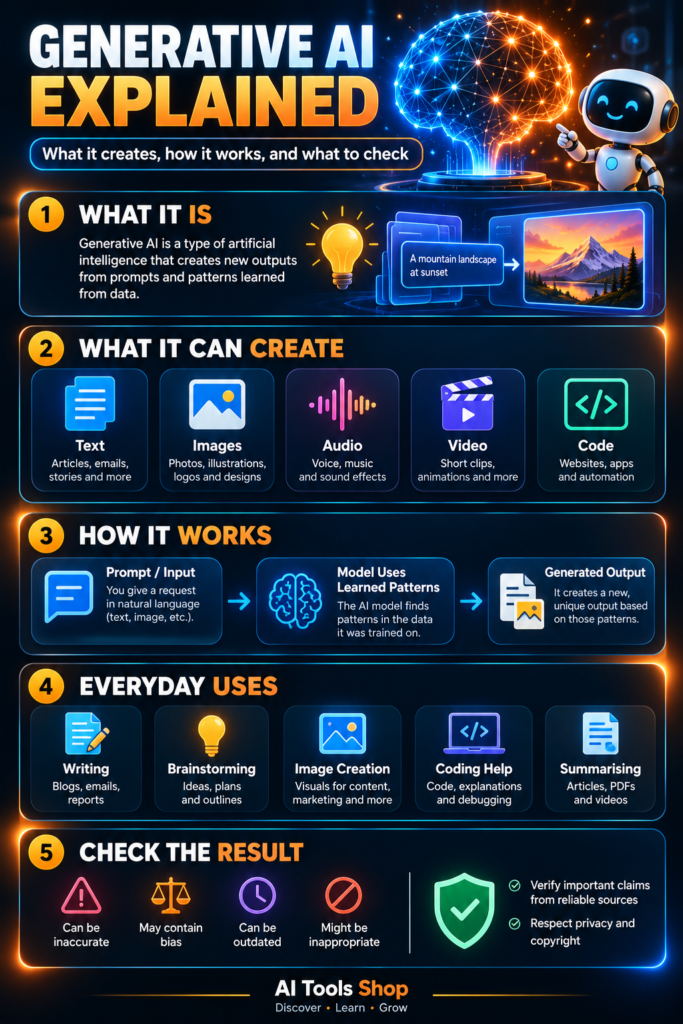
Generative AI explained: visual guide
This infographic summarises the main idea: generative AI receives a prompt, uses patterns learned during training to produce content, and should have its output checked before it is used or shared.
Why is everyone talking about generative AI?
Several changes help explain the attention GenAI receives. Conversational interfaces made sophisticated models easier for ordinary users to try; text, image, audio, and code tools became available through web apps and familiar workflows; and businesses began exploring ways to use them in existing products and processes. The technology has also triggered public debate because it can affect work, education, creative industries, privacy, and information quality.
The OECD notes that generative AI gained global attention in 2022 with the rise of text-to-image generators and large language models. Its current overview also describes adoption across different groups and highlights both potential benefits and risks. According to the OECD’s page, more than one-third of individuals across OECD countries used generative AI tools in 2025, although uptake is uneven across population groups. Read the OECD generative AI overview for its context and latest figures.
What are the main uses of generative AI?
Writing, brainstorming, and summarising
Text assistants can help users brainstorm topics, organise notes, create first drafts, explain unfamiliar concepts, or summarise material they provide. They are most useful when the person supplies direction, evaluates the results, and adds context or experience that the model does not know.
If you are building a writing workflow, see our guide to free AI writing tools for more options. Treat AI output as a draft to review, not as an automatic substitute for research and editing.
Images, design, and creative work
Image generators can help create concept visuals, backgrounds, illustrations, and design directions from text prompts. They can support early exploration, but you should inspect the result for errors, avoid misleading depictions, and check the tool’s terms and the rights associated with assets before commercial use.
Coding and software development
AI coding tools can suggest code, explain an unfamiliar function, help write tests, or propose ways to investigate a bug. Generated code still needs review and testing: it can be insecure, incorrect, incomplete, or incompatible with your project. Never paste secrets such as passwords or API keys into a tool unless the applicable service policy and workflow expressly support that use.
Learning and education
Generative AI can explain topics at different levels, generate practice questions, and help learners explore examples. Students should follow their school’s or university’s rules, check answers against course materials, and avoid presenting AI-generated work as their own when that violates academic requirements.
Customer service and business operations
Businesses can use generative AI to draft responses, summarise support conversations, create internal knowledge resources, or help staff find information. Human review remains important for sensitive customer cases, regulated content, and decisions that have a meaningful impact on people. Organisations should evaluate privacy, access controls, accuracy, security, and how the tool fits existing processes.
What are the benefits of generative AI?
- Faster first drafts: it can help turn a brief into an outline or initial version for a person to improve.
- More ways to explore ideas: users can quickly compare formats, examples, and creative directions.
- Accessible interfaces: people can often interact using ordinary language rather than specialist software commands.
- Support for routine tasks: it may help with summaries, common questions, templates, and repetitive content work.
- Rapid prototyping: teams can explore concepts, sample code, and product ideas before investing more effort.
These are possible benefits rather than guaranteed outcomes. Results depend on the task, model quality, workflow, human review, and the cost of correcting errors.
What are the risks and limitations?
Generative AI can create real value, but responsible use means understanding where it can go wrong. NIST’s Generative AI Profile outlines risks and risk-management considerations for organisations developing or using these systems. Common concerns include:
- Hallucinations and factual errors: a response may sound certain even when it is wrong or unsupported.
- Bias and harmful content: outputs can reproduce unfair patterns or produce unsuitable material.
- Privacy and confidentiality: information entered into a service may be handled according to the provider’s policies and settings.
- Intellectual property: generated content may raise questions about source material, attribution, licensing, and the rights to use an output.
- Misuse and misinformation: realistic text, voice, images, or video can be used to mislead others.
- Uneven quality: performance may vary across languages, topics, tasks, and user groups.
- Human overreliance: users may trust outputs without checking the evidence or consequences.
For a deeper look at organisational risks, read NIST’s Artificial Intelligence Risk Management Framework: Generative AI Profile. The framework is a risk-management resource, not a promise that a model can be made error-free.
Generative AI vs. traditional AI: what is the difference?
Traditional AI applications are often designed to classify, predict, rank, or recommend. Generative AI is designed to produce new content such as text, images, audio, video, or code. These categories can overlap: a product may use a predictive model to select information and a generative model to explain or present it.
| Aspect | Predictive or classification-focused AI | Generative AI |
|---|---|---|
| Typical goal | Predict a value, rank options, or assign a category | Create content based on a prompt or other input |
| Example output | Spam score, demand forecast, recommended item | Draft, image, audio clip, video, or code suggestion |
| Common question | “Which category is this?” or “What may happen?” | “Create an explanation, image, or draft about this.” |
| Shared concerns | Accuracy, bias, privacy, security, and evaluation | Accuracy, bias, privacy, security, originality, and misuse |
The distinction is a useful starting point, not a strict dividing line. Generative models can also support analysis, and AI products often combine multiple approaches.
How can beginners use generative AI responsibly?
You do not need to be an expert to get started. Choose a low-risk task, tell the tool what you want, provide relevant context, and review the result. These habits help keep the output useful and reduce avoidable mistakes.
- Be specific: include your goal, audience, context, format, and constraints.
- Ask for alternatives: compare a few options instead of assuming the first response is best.
- Verify important claims: open trusted sources, especially for current, technical, medical, legal, or financial information.
- Protect private data: do not submit confidential or sensitive information without understanding the service’s terms and controls.
- Check content rights: follow applicable licences, attribution requirements, copyright rules, and workplace policies.
- Keep human responsibility: make the final decision yourself, especially when errors could affect people.
For more beginner-friendly context, explore our AI basics guide, how AI works, and the difference between AI, machine learning, and deep learning.
Frequently asked questions
Is generative AI the same as artificial intelligence?
No. Artificial intelligence is the broader field. Generative AI is a category of AI focused on creating outputs such as text, images, audio, video, or code.
Does generative AI copy its training data?
Generative models learn patterns from training data and produce outputs based on those learned patterns and the input they receive. Whether an output reproduces or resembles existing material depends on the model, prompt, data, and result. Do not assume every output is wholly unlike existing work or automatically free of intellectual-property concerns.
Can generative AI be wrong?
Yes. It can produce incorrect facts, invented details, biased content, or outputs that do not follow instructions. Verify important information against trustworthy sources and review the output before using it.
Is generative AI free to use?
Some services offer free access or limited free plans, while others require payment for particular models, features, or higher usage. Check each provider’s current pricing, usage limits, regional availability, and terms.
Will generative AI replace writers, designers, or programmers?
Its effects will vary by occupation, task, industry, and how organisations use the technology. Generative AI can assist with parts of creative and technical work, but people still provide goals, context, judgement, quality control, and accountability. It is more accurate to assess specific tasks than to assume an entire profession will be replaced.
Final thoughts
Generative AI is attracting attention because it makes content creation and other AI capabilities accessible through familiar interfaces. It can generate text, images, audio, video, and code, supporting experimentation, learning, and productivity. However, it can also make mistakes and raise important issues around privacy, bias, copyright, and misuse.
The best way to approach generative AI is with curiosity and healthy scepticism: use it to explore possibilities, verify consequential claims, protect sensitive information, and apply human judgement before sharing or acting on the output. Keep exploring AI Tools Shop for practical explainers and beginner-friendly AI guides.
Official sources and further reading
- NIST: Generative artificial intelligence glossary
- OECD: Generative AI — opportunities, adoption, and risks
- IBM: What is generative AI?
- Google: Learn about generative AI
- NIST: Generative AI Risk Management Framework Profile
Editorial note: Generative AI capabilities and product terms change frequently. This article uses public information from official and institutional sources and does not claim to independently benchmark or test specific products.