
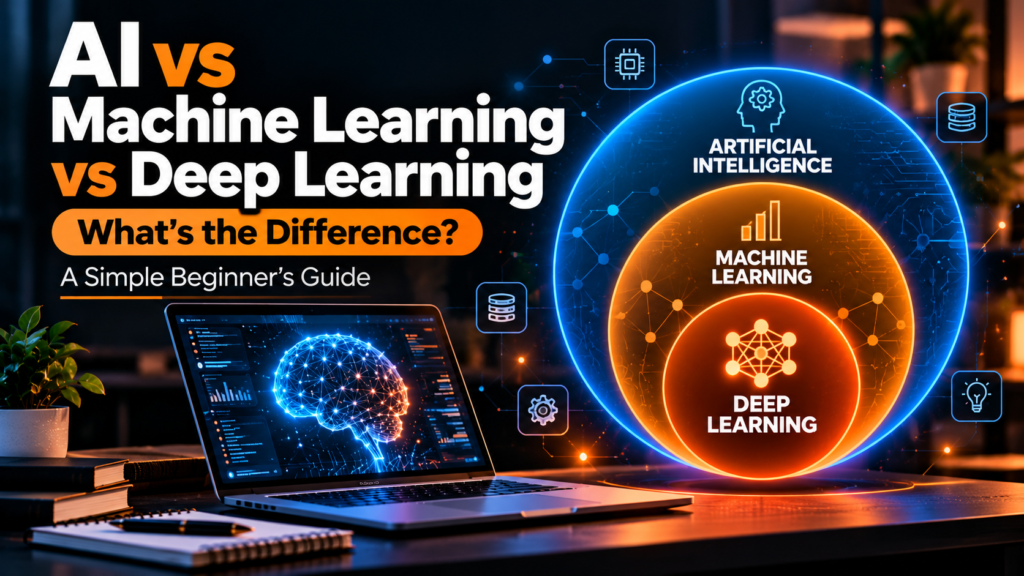
Artificial intelligence (AI), machine learning (ML), and deep learning (DL) are closely related terms, but they do not mean the same thing. AI is the broad field of building systems that perform tasks associated with abilities such as reasoning, recognising patterns, or making recommendations. Machine learning is one approach within AI: models learn patterns from data. Deep learning is a type of machine learning that uses neural networks with multiple layers.
The simplest way to remember the relationship is: deep learning is a subset of machine learning, and machine learning is a subset of AI. This is a useful way to understand the terms, although AI also includes approaches that do not rely on machine learning. Google Cloud explains this distinction in its AI vs. machine learning vs. deep learning guide.
If you are just learning the basics, read our introductions to what artificial intelligence is and how AI actually works alongside this comparison.
What is the difference between AI, machine learning, and deep learning?
Think of these as nested categories rather than three completely separate technologies. AI describes the broad goal and field. Machine learning covers methods that fit models using data instead of relying only on hand-written rules. Deep learning uses multi-layer neural networks to learn complex patterns and representations from data.
| Term | Plain-English meaning | Example |
|---|---|---|
| Artificial intelligence (AI) | The broad field of building systems that perform tasks such as perception, reasoning, planning, or decision support. | A rule-based troubleshooting assistant or a system that recommends a route. |
| Machine learning (ML) | A subset of AI in which a model learns patterns from data to make predictions or classifications. | An email spam filter trained on examples of spam and legitimate messages. |
| Deep learning (DL) | A subset of ML using neural networks with multiple layers to learn more complex patterns. | A neural network that recognises objects in photos or processes speech. |
What is artificial intelligence (AI)?
Artificial intelligence is the broad area of computer science focused on creating systems that can perform tasks that may involve perception, language, planning, learning, problem-solving, or decision-making. AI is not one single algorithm. It includes different methods, from rule-based systems to statistical models and modern neural networks.
For example, a simple rule-based assistant might troubleshoot a printer by asking questions and following a decision tree: if the printer is offline, check the connection; if it has no paper, refill the tray. This is a form of AI-style automation even if the system does not learn patterns from a training dataset.
AI is the umbrella term. The specific approach depends on the task, available data, reliability requirements, and cost. Some AI problems can be handled well with straightforward rules; others benefit from machine learning or deep learning.
What is machine learning (ML)?
Machine learning is a branch of AI that uses data to train a model to recognise patterns and produce outputs such as predictions, classifications, or recommendations. Rather than writing a separate rule for every possible example, developers choose a learning method, prepare data, train a model, and evaluate how well it performs on examples it has not seen before.
Imagine an email spam filter. Developers can train a model using examples labelled “spam” and “not spam.” The model learns patterns associated with each category and then estimates which category best fits a new email. The result is not guaranteed to be right, so real systems need evaluation and ongoing monitoring.
Machine learning includes several approaches. Supervised learning uses labelled examples, unsupervised learning looks for structure in data, and reinforcement learning trains an agent to choose actions using feedback signals. The best method depends on the problem, data, and what the system needs to achieve. Google’s Machine Learning Glossary explains common terms such as models, training, neural networks, and evaluation.
What is deep learning (DL)?
Deep learning is a specialised type of machine learning built around artificial neural networks with multiple layers. These layers transform input data into increasingly useful representations for a task. During training, the network adjusts its internal parameters to reduce errors according to a chosen objective.
Deep learning is especially useful for complex data such as images, audio, video, and language. It powers many modern speech-recognition systems, image-recognition applications, and large language models. However, deep learning often requires more computing resources and training data than simpler machine-learning methods, and its internal behaviour can be harder to interpret.
For example, an image-recognition model may learn patterns that help it identify a cat in a photo. Earlier layers may respond to simple visual patterns, while later layers can combine those patterns into more complex representations. This is a simplified explanation; actual neural-network architectures can be far more sophisticated.
AI vs machine learning vs deep learning: visual comparison
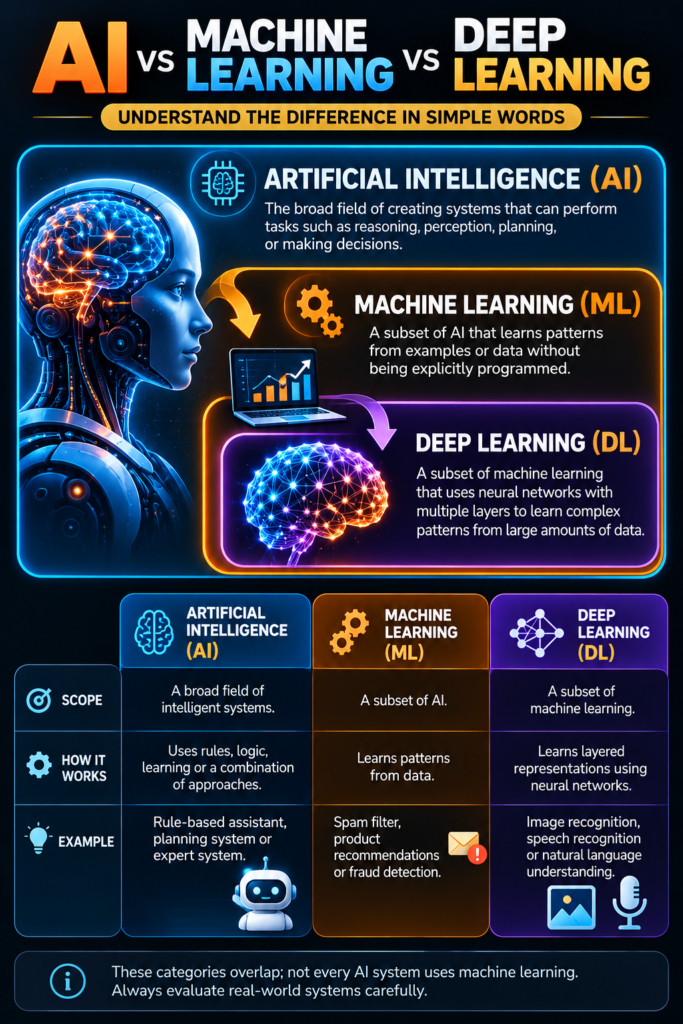
The infographic below shows the relationship between the three terms. AI is the broad category, ML sits inside AI, and DL sits inside ML. It also gives examples of how each area is commonly used.
How are AI, machine learning, and deep learning connected?
It helps to picture the relationship as a set of nested circles. The largest circle represents AI. Inside it is machine learning, and inside machine learning is deep learning. The important detail is that not every AI system uses ML, and not every ML model uses deep neural networks.
- AI without machine learning: a rule-based expert system or a planner that searches possible actions using explicit logic.
- Machine learning without deep learning: a decision tree or a gradient-boosted model predicting customer churn from structured data.
- Deep learning: a neural network with multiple layers learning useful patterns from images, speech, text, or other complex inputs.
Real-world examples: which technology is used where?
Spam detection
An email service may use machine learning to estimate whether an incoming message is spam based on signals learned from examples. The wider spam-filtering product is an AI application; the particular prediction model might be a conventional ML model or a deep-learning model, depending on its design.
Photo recognition
A photo app that recognises faces, pets, or objects may use deep learning because multi-layer neural networks can learn complex visual patterns. The overall feature is an AI application, and deep learning is one of the methods that can power it.
Recommendations
A streaming service might recommend a film based on viewing history and patterns across similar users or content. This may involve machine learning, but the full recommendation system can also include business rules, ranking methods, and other components.
Chatbots and generative AI
Many modern chat assistants use deep-learning models, often large neural networks trained on text and other data. These models generate responses based on the prompt and conversation context. The product may also use search, retrieval, safety checks, and other software components, so the user-facing assistant is usually more than a single model.
Which one needs more data and computing power?
There is no universal resource ranking for every possible system, but a common pattern is that simple rule-based AI can need little training data, many conventional ML models can work with moderate datasets, and large deep-learning systems often require substantial data and computing. The requirements depend on the model, task, data quality, hardware, and desired performance.
Deep learning is not automatically the best choice. For structured business data, a simpler model may be faster, easier to maintain, and easier to explain. For complicated image, audio, or language tasks, a deep neural network may offer capabilities that are difficult to achieve with simpler approaches. A good design compares possible methods rather than assuming the newest or largest model is always best.
Comparison table: AI vs ML vs DL
| Feature | AI | Machine learning | Deep learning |
|---|---|---|---|
| Scope | Broad field | Subset of AI | Subset of ML |
| Main idea | Make systems perform intelligent tasks | Learn patterns from data | Learn complex representations with multi-layer neural networks |
| Can work without learned data? | Yes, for example with explicit rules | Typically learns from training data | Trained neural networks require data |
| Common examples | Rule-based expert systems, planning, virtual assistants | Spam filtering, forecasting, recommendation models | Image, speech, language, and complex pattern recognition |
| Computing needs | Varies widely | Varies by model and task | Often higher for training large networks |
| Interpretability | Rules may be easy to inspect; complex AI may not be | Simple models can be interpretable | Complex networks can be harder to explain |
How should a beginner learn AI, ML, and DL?
If your goal is to understand the concepts, start with AI fundamentals and examples before diving into algorithms. If you want to build models, learn basic Python, data handling, statistics, and model evaluation, then practise with small datasets. Deep learning becomes easier to understand after you know how training, loss, parameters, and neural networks work at a basic level.
- Step 1: Learn the meaning of AI, ML, deep learning, training data, and model.
- Step 2: Try beginner-friendly AI tools and observe what they do well and where they fail.
- Step 3: If you want to build models, learn Python and practise with a small classification or prediction exercise.
- Step 4: Learn model evaluation, data quality, bias, and why a test set matters.
- Step 5: Explore neural networks and deep learning when you are ready for the extra complexity.
For practical next steps, see our guides to AI basics, how AI works, and AI tools for beginners.
Frequently asked questions
Is machine learning the same as AI?
No. AI is the broader field. Machine learning is a subset of AI that uses data to train models to identify patterns and make predictions, classifications, or recommendations.
Is deep learning part of machine learning?
Yes. Deep learning is a type of machine learning that uses neural networks with multiple layers to learn complex patterns from data.
Can AI work without machine learning?
Yes. Rule-based systems, search methods, and explicit planning approaches can be considered AI techniques without using a model trained from data.
Is deep learning always better than traditional machine learning?
No. Deep learning can be powerful for complex data, but it may need more data, computing resources, and maintenance. Simpler ML methods can be a better choice for some structured datasets or when interpretability is important.
Which should I learn first: AI, ML, or deep learning?
Start with AI concepts and everyday applications. If you want to build models, study machine-learning basics next. Learn deep learning after you understand fundamental ideas such as training, model parameters, and evaluation.
Final thoughts
AI, machine learning, and deep learning are related but distinct. AI is the broad field; machine learning is an approach that learns patterns from data; and deep learning uses multi-layer neural networks for complex patterns. Knowing the difference helps you understand how modern AI products are built and why tools with similar labels may work in very different ways.
Keep learning with AI Tools Shop’s beginner guides, starting with What Is Artificial Intelligence? and How Does AI Actually Work?.
Official sources and further reading
- Google Cloud: Deep learning vs. machine learning vs. AI
- Google Cloud: AI vs. machine learning
- Google for Developers: Machine Learning Glossary
Editorial note: This article explains commonly used definitions and relationships. Specific AI products can combine rules, conventional machine learning, deep learning, retrieval, and other software components. No independent product benchmark or hands-on performance test is claimed.