

Prompt engineering is the practice of designing, testing, and refining instructions so an AI model produces a more useful response. It can mean specifying a task, adding context, setting constraints, providing examples, choosing an output format, and checking whether the result meets your needs.
Is prompt engineering still worth learning in 2026? Yes—as a practical skill for working with AI tools, automating tasks, and building reliable AI workflows. But the most durable skill is not memorising magic phrases. It is learning to describe problems clearly, provide the right information, test outputs, and adapt your approach to the model and task. For advanced applications, prompt design works alongside structured inputs, tools, software, and evaluation—not instead of them.
This guide explains prompt engineering in plain English, shows a reusable prompt formula, compares vague and specific prompts, and covers the skills that matter as AI models improve.
For related foundations, read our guides to large language models (LLMs), generative AI, and agentic AI vs. chatbots.
What Is Prompt Engineering?
Prompt engineering is the process of writing and improving instructions for an AI model so its response better matches a goal. A prompt might be a question, a task description, source material to analyse, an example of the desired answer, or a structured set of requirements.
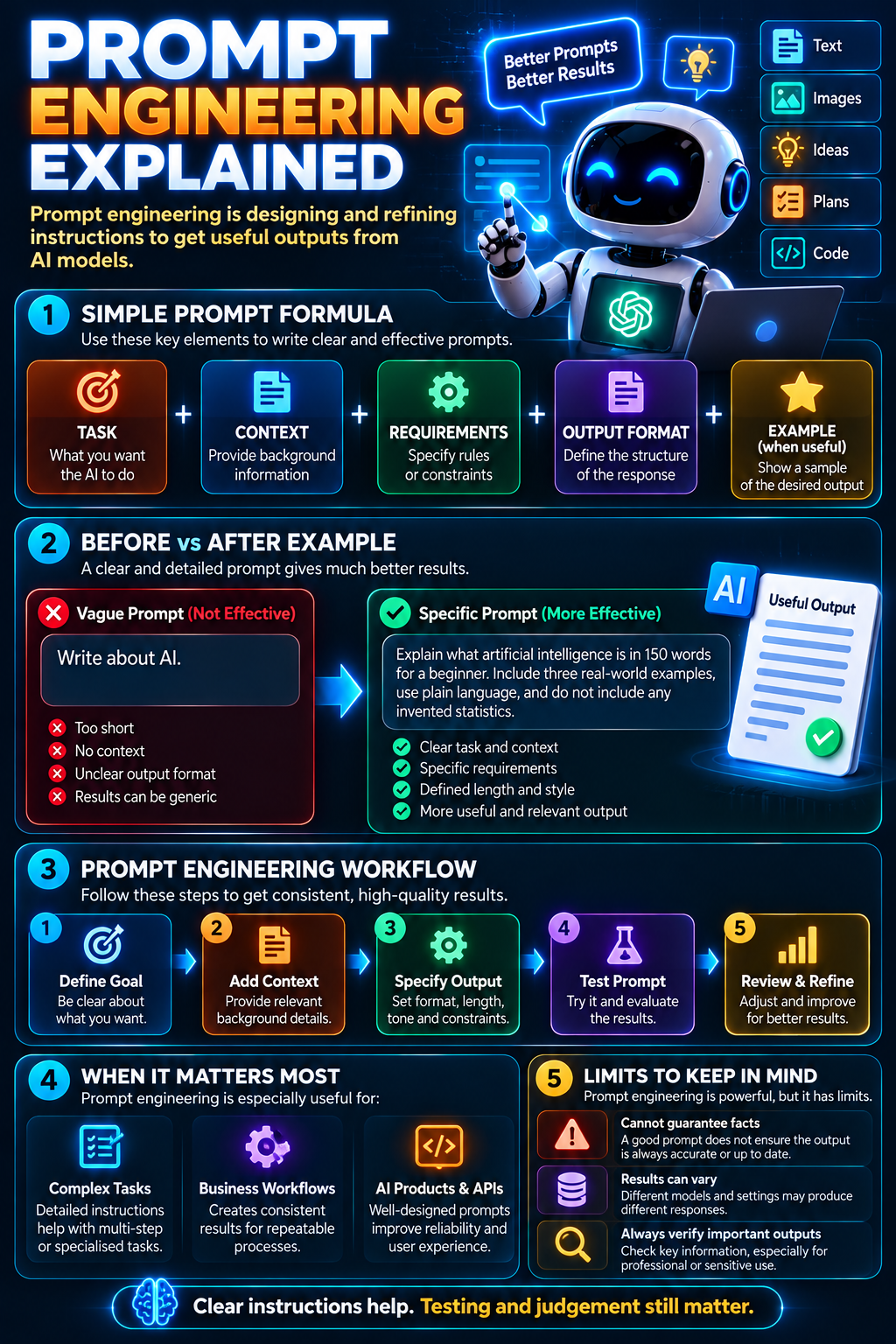
For example, “Write about AI” gives a model little guidance. “Explain artificial intelligence to a beginner in 150 words, give three everyday examples, use plain English, and do not invent statistics” defines the audience, length, examples, style, and an important constraint.
Prompt engineering does not guarantee a correct answer. AI output can vary between runs and models, and even well-written instructions cannot replace fact-checking or appropriate software controls. OpenAI describes prompt engineering as writing effective instructions so models more consistently produce outputs that meet requirements. See the official OpenAI prompt engineering guide.
How Do Prompts Influence AI Responses?
A prompt provides the task and context the model uses to generate an answer. Clearer instructions can reduce ambiguity about what you want, which details matter, and how the answer should be presented. Examples can demonstrate the desired format, while constraints can limit length or rule out unwanted content.
However, prompts are only one part of the system. Results also depend on the model, its training, available context, tools, settings, and the quality of information supplied. Some tasks need a simple natural-language request; others benefit from retrieval, structured outputs, repeated testing, or software checks.
Table of Contents
What Is a Simple Prompt Engineering Formula?
A useful starting point is to combine five elements: task, context, requirements, output format, and an example when helpful. Not every prompt needs all five. Use the components that remove meaningful ambiguity.
- Task: Say exactly what you want the model to do.
- Context: Explain the audience, situation, source information, or purpose.
- Requirements: State constraints, exclusions, quality criteria, length, tone, or steps that matter.
- Output format: Request a table, checklist, email, JSON object, outline, or another appropriate structure.
- Example: When format or style is difficult to describe, provide a representative input and output.
Copy-and-adapt template:
Task: [What should the AI do?]
Context: [Who is this for, and what background matters?]
Requirements: [Must include, must avoid, length, tone, constraints]
Output format: [Table, steps, email, outline, or other format]
Quality check: [How should the answer be checked? State uncertainty and do not invent facts or sources.]
This is a practical template, not a universal formula or guaranteed shortcut. Different models respond differently, and a short direct prompt can be better than a long prompt when the task is simple.
Prompt Engineering at a Glance
This infographic summarises the prompt formula, a vague-versus-specific example, and a repeatable workflow for testing and improving prompts.
What Is the Difference Between a Vague Prompt and a Specific Prompt?
Compare these two requests.
Vague prompt
Write a blog post about AI.
The model has to guess the audience, angle, length, structure, and what “good” means. The result may be generic because the request leaves many decisions open.
More specific prompt
Write a beginner-friendly introduction to artificial intelligence for readers with no technical background. Use about 800 words, explain three everyday examples, define technical terms, include a short FAQ, and link to official references for factual claims. Do not invent statistics or claim hands-on testing. Use clear H2 headings and end with practical next steps.
The second prompt gives the model a clearer audience, scope, structure, and quality criteria. It still needs editorial review: the AI may misunderstand the task, include errors, or use unsuitable sources. Better instructions improve the odds of a useful output; they do not guarantee it.
Which Prompt Engineering Techniques Are Most Useful?
1. Be clear and direct
Put the main task near the beginning. Use concrete verbs such as summarise, compare, extract, draft, classify, or explain. Avoid conflicting instructions and specify ambiguous terms.
2. Provide relevant context
Explain why the task matters, who will use the answer, and which facts or source material the model should rely on. If the answer must be grounded in a document, provide that document or relevant excerpts and tell the model not to fill gaps with guesses.
3. Specify the output format
If you need a table, checklist, short email, step-by-step guide, or machine-readable output, say so. For complex software use, a schema or a format-enforcing feature may be more reliable than relying on instructions alone.
4. Use examples when the desired pattern is hard to explain
One or more examples can show the tone, category labels, structure, or level of detail you want. Keep the examples accurate and representative; poor examples can teach the wrong pattern.
5. Break complex tasks into stages
For a complex job, separate research, outline, drafting, checking, and final formatting when you need to inspect intermediate results. For simpler tasks, one well-scoped prompt may be enough. Extra steps add time and complexity, so use them when they improve control or quality.
6. Iterate based on actual results
If the response misses the goal, identify the gap: missing context, wrong length, unsupported claims, or an unsuitable format. Update the relevant instruction and try again. Changing one meaningful variable at a time can make it easier to see what improved the result.
7. Ask for uncertainty and source discipline
For factual tasks, ask the model to distinguish supported information from uncertainty and to identify claims that need verification. Always open cited sources yourself; a prompt cannot guarantee that a generated citation exists or supports the claim.
8. Evaluate prompts systematically for repeated work
If a prompt powers a recurring business or application workflow, test it on representative examples, including difficult cases. Record errors, measure task-specific outcomes, and rerun evaluations after you change the prompt or model. OpenAI recommends treating production prompts as part of the application and testing changes; see its prompt engineering guidance.
What Are Practical Prompt Engineering Examples?
Example 1: Research a topic
Research [topic] for a beginner audience.
Use reliable primary or official sources where available.
Summarise the main points in a table with columns for
claim, source, and caveat.
Flag anything you cannot verify.
Do not invent quotes, statistics, or citations.
Example 2: Improve an email
Rewrite the email below to sound clear, polite, and professional.
Keep the meaning and all factual details unchanged.
Keep it under 150 words.
Do not add promises, deadlines, or commitments not in the original.
Return only the revised email.
Example 3: Create a blog outline
Create a search-friendly outline for a beginner article about [topic].
Answer the main question near the beginning.
Include related questions, examples, limitations, and FAQs.
Suggest internal links only where genuinely relevant.
Mark claims that need current research.
Do not repeat headings just to include keywords.
Example 4: Help debug code
Help diagnose this error.
Environment: [language, version, framework]
Expected behaviour: [what should happen]
Actual behaviour: [error and observed result]
Relevant code and logs: [paste here]
First identify likely causes and missing information.
Then suggest the smallest safe fix and tests.
Do not claim the code has been run unless it has.
Example 5: Analyse customer feedback
Classify each feedback message into one category:
bug, billing, feature request, praise, or other.
Return a table with message ID, category, and a short reason.
Do not infer personal traits or details not stated in the message.
Mark uncertain cases for human review.
Use only the text supplied below.
These templates work as starting points. Adapt them to the exact model, task, available data, and any privacy or compliance rules that apply to your work.
Is Prompt Engineering Still Worth Learning in 2026?
Yes, if you learn it as a practical problem-solving skill—not as a collection of secret phrases. People who work with AI benefit from being able to define a task, share relevant context, specify constraints, judge outputs, and improve a workflow based on evidence.
The skill is evolving. As models improve at following natural-language instructions, users may need fewer elaborate tricks for everyday requests. At the same time, complex or repeatable workflows still benefit from prompt design, structured context, examples, tool instructions, evaluations, and safeguards.
Official guidance from multiple AI providers points in a similar direction: use clear, specific instructions; provide useful context; use examples where appropriate; and refine prompts through experimentation. Google describes prompt design as iterative and recommends trying and refining strategies for a particular use case. Anthropic also emphasises clarity, context, examples, and structured prompts in its prompt engineering documentation. See also Google’s prompt design strategies.
However, “prompt engineer” as a standalone job title is different from prompt engineering as a useful skill. Hiring demand and role expectations vary by company and change over time; it would be misleading to promise a job or salary simply because someone learns prompt techniques. Employers may value domain knowledge, evaluation, automation, coding, data skills, product thinking, or security alongside prompting.
Which Skills Matter More Than Prompt Tricks?
To make prompt engineering durable, combine it with skills that help you deliver an actual outcome.
- Problem definition: translate a vague request into a measurable goal and clear acceptance criteria.
- Domain knowledge: understand the subject well enough to spot mistakes and judge whether the answer is useful.
- Research and fact-checking: use trustworthy sources and distinguish evidence from speculation.
- Evaluation: test model outputs, document failure cases, and compare results against criteria.
- Data and privacy awareness: know what information can be shared and how outputs should be handled.
- Workflow design: decide when prompts are enough and when the task needs retrieval, tools, structured outputs, or human review.
- Technical fluency: for product and automation work, learn APIs, data formats, version control, and basic scripting as appropriate.
The key principle is simple: a prompt is only one component in a larger workflow. If an incorrect output could cause serious harm, instructions alone are not an adequate safety system.
What Are Common Prompt Engineering Mistakes?
- Being too vague: asking for “something good” without explaining the purpose or quality criteria.
- Overloading the prompt: combining unrelated tasks and conflicting rules in one instruction.
- Assuming a role guarantees expertise: telling a model “act as an expert” does not prove it has accurate knowledge.
- Trusting invented details: fluent wording and confident tone do not establish factual correctness.
- Using outdated prompt recipes blindly: approaches that work for one model may perform differently on another.
- Ignoring context limits: providing too much irrelevant material can obscure what matters.
- Not testing recurring prompts: a prompt can fail on unusual inputs or after a model update.
- Sharing sensitive data unnecessarily: do not include passwords, private customer records, or confidential material unless the use is authorised and the service settings are appropriate.
- Believing longer is always better: extra words are helpful only when they clarify the task or constraints.
How Can You Build a Repeatable Prompt Engineering Workflow?
- Define success: write down what a good result must do and which failures matter.
- Create a first prompt: state the task, context, requirements, and output format.
- Choose representative test cases: include normal requests, edge cases, and examples where the answer should be “I don’t know” or “needs review.”
- Run and inspect results: compare outputs against the criteria, not just personal preference.
- Improve the weakest part: revise context, constraints, examples, or format based on the observed failure.
- Retest after changes: check that the improvement did not break other cases.
- Document the working version: keep a named version and note what it is intended to do, which model it uses, and what limitations remain.
- Monitor real use: collect failures responsibly and update the workflow when the model, data, or requirements change.
This process is especially useful when prompts are part of a product or business workflow. For occasional personal tasks, a simpler process—write clearly, review the response, refine once or twice—may be all you need.
What Can Prompt Engineering Not Fix?
Prompt engineering cannot guarantee truth, eliminate model bias, create access to information the system does not have, or replace proper permissions and validation. If the model lacks current information, use reliable current sources or an approved search tool. If a workflow requires exact data structures, use a schema or validation step where available. If actions affect real customers or systems, add permissions, logging, testing, and human approval as appropriate.
For AI-assisted writing and publishing, use prompts to plan and draft, but verify claims, sources, links, and dates before publishing. Our guides to generative AI and LLMs explain why generated outputs need review.
Frequently Asked Questions About Prompt Engineering
What is prompt engineering in simple words?
Prompt engineering is writing and refining instructions for an AI model so the response better fits a task. It often involves clarifying the goal, providing context, setting requirements, choosing an output format, and reviewing the result.
Is prompt engineering still worth learning in 2026?
Yes, as a practical skill for using AI effectively. The most valuable approach is to combine clear prompting with subject knowledge, evaluation, fact-checking, and workflow design. Memorising fixed prompt formulas alone is less durable because models and tasks differ.
Can prompt engineering get me a job?
Learning prompt engineering can support work in AI-assisted content, operations, automation, product development, research, and other fields. It does not guarantee a job or a particular salary. Roles may also require domain expertise, coding, testing, data analysis, or experience with AI systems.
What is the best formula for a prompt?
A useful starting template is task + context + requirements + output format, with examples added when they help. There is no single best formula for every model and use case, so test the prompt against the task you need to solve.
Should prompts be long or short?
Use the shortest prompt that clearly communicates the task and constraints. Complex tasks may need more context, examples, or structured sections, while simple requests often work well with a direct question.
Does telling AI to “act as an expert” improve results?
A role description may help set tone, perspective, or scope, but it does not prove the model has expert knowledge. Provide relevant context and criteria, and verify important facts regardless of the role you assign.
Do prompts work the same across ChatGPT, Claude, and Gemini?
General principles such as clarity, relevant context, specific output requirements, and iterative testing are useful across models. However, recommended techniques can vary by model family, version, and task, so check the provider’s current documentation and test your own use case.
Can a good prompt stop AI hallucinations?
No. Asking the model to state uncertainty, use supplied sources, and avoid unsupported claims can help, but prompts cannot guarantee correctness. Verify important claims using authoritative sources and use tools or validation steps when needed.
Final Thoughts: Learn the Skill, Not Just the Tricks
Prompt engineering remains worth learning because it helps people communicate goals clearly, give AI the right context, shape useful outputs, and evaluate whether the result works. In 2026, the strongest approach combines prompting with domain knowledge, testing, data awareness, and workflow design.
Start with a clear request, refine it based on the output, and verify anything important. When the task becomes repetitive or high-stakes, add structured inputs, evaluation, permissions, and human review rather than expecting a clever prompt to solve everything.
Keep exploring AI Tools Shop for practical tutorials on AI basics, generative AI, large language models, and agentic AI.
Official Sources and Further Reading
- OpenAI: Prompt Engineering
- OpenAI Help Center: Best Practices for Prompt Engineering
- Anthropic: Prompt Engineering Overview
- Google AI for Developers: Prompt Design Strategies
- Google Search Central: Creating Helpful, Reliable, People-First Content
Editorial note: Prompting recommendations vary across models, versions, and tasks. This guide synthesises public provider documentation and does not claim independent testing of every method or product. Job outcomes and search rankings cannot be guaranteed.