

AI tokens are the small pieces of text that an AI model processes and generates. A token can be a complete word, part of a word, a character, or punctuation, depending on the model’s tokenizer. When you send a prompt to an AI assistant, the text is converted into tokens before the model processes it; the response is then generated as output tokens.
Tokens matter because they affect how much information fits into a model’s context window, how long a response can be, and—when you use many API services—how usage and costs are calculated. Understanding tokens helps you write more efficient prompts, estimate request size, and avoid confusing a word count with a token count.
This beginner-friendly guide explains what AI tokens are, how tokenization works, why tokens are not the same as words, how token IDs are used, and how to check token counts for a specific model.
If you are learning how language models work, continue with our guides to large language models (LLMs), transformer models, and generative AI.
What is a token in AI?
A token is a unit of information that a model’s tokenizer uses to represent input or output. In text-based AI systems, tokens are commonly chunks of text. A token might represent a whole word, a word fragment, punctuation, or a sequence that includes a space.
For example, a common short word may be represented by one token, while a longer or less common word may be divided into several smaller pieces. The exact result depends on the tokenizer and model. Tokens are therefore not identical to words, letters, or syllables.
OpenAI explains that tokens can represent a character, part of a word, a whole word, or punctuation, and that spaces can affect how text is split. Google’s Gemini documentation describes tokens in a similar way: a token can be a single character, a whole word, or part of a longer word. See the official explanations from OpenAI and Google AI for Developers.
What is tokenization in artificial intelligence?
Tokenization is the process of dividing text into tokens that a model can process. A software component called a tokenizer applies a model-specific vocabulary and set of rules to turn text into a sequence of token units.
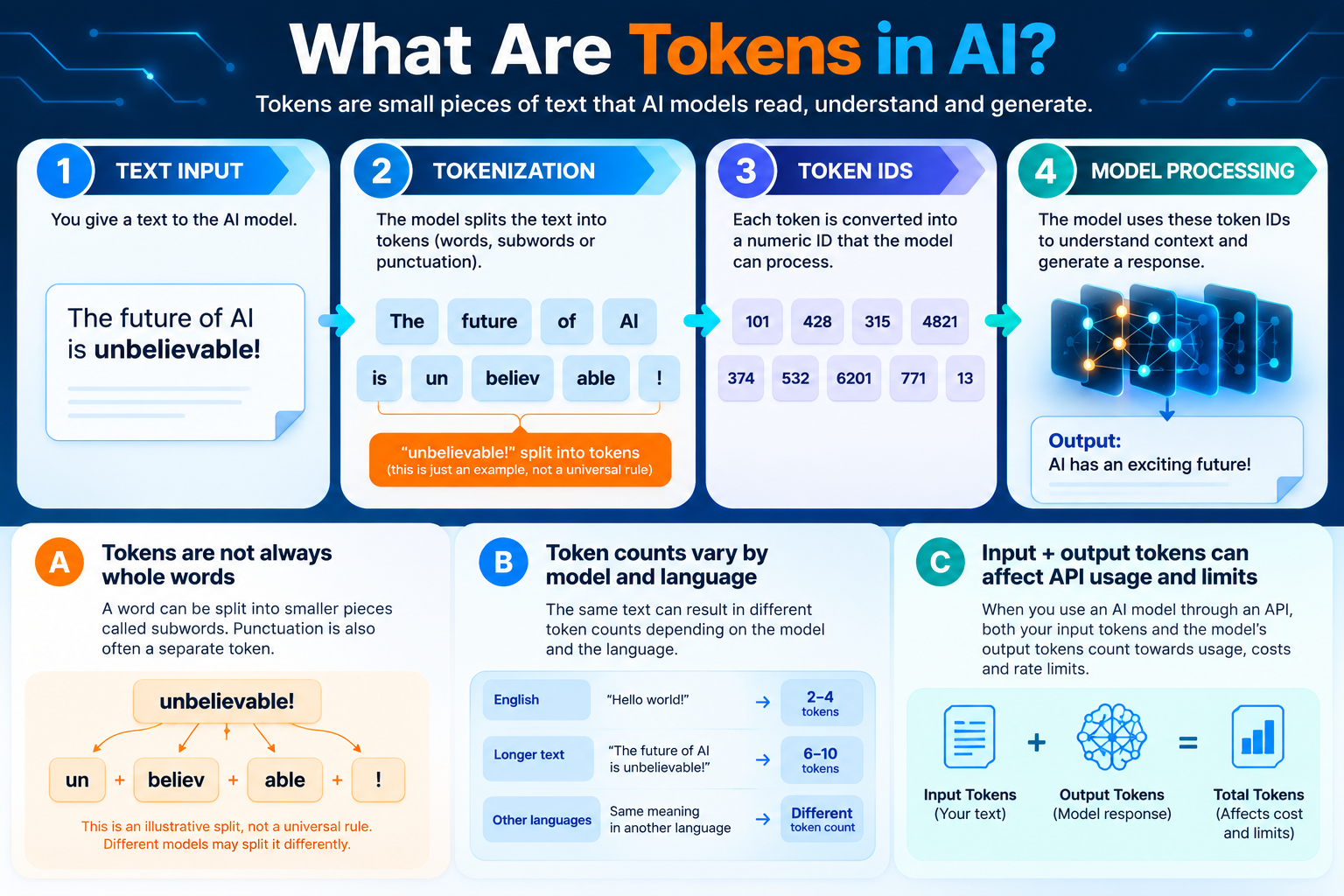
Consider the sentence:
“The future of AI is unbelievable!”
A tokenizer might represent common words as individual tokens and split a less common word into smaller pieces. Punctuation may also become its own token. The exact split is not universal: a different model or tokenizer may divide the same sentence differently.
For example, OpenAI’s documentation gives “ tokenization” as an example that can be represented as “ token” and “ization”. This illustrates why a token boundary does not always match a space between words. It is an example for a particular encoding, not a rule that every model must follow.
AI tokenization explained visually
This infographic shows how text can be split into token pieces, mapped to token IDs, and processed by an AI model. The illustrated splits and numbers are examples only; actual tokenisation depends on the model and tokenizer.
What does an AI tokenizer do?
A tokenizer prepares text so the model can work with it. In a simplified text workflow, it performs several related operations:
- Receives text: the tokenizer gets the prompt, document, or conversation text.
- Splits the text: it identifies token units according to its vocabulary and tokenization method.
- Maps tokens to IDs: each token is associated with a numerical identifier from the tokenizer’s vocabulary.
- Passes the sequence onward: the model uses these IDs and their learned representations to process the input.
- Decodes generated tokens: when the model produces output token IDs, the tokenizer converts them back into readable text.
Tokenization is not the same as understanding. The tokenizer prepares the input; the model’s neural network processes the resulting representations and produces predictions or other outputs. For a deeper explanation of the model itself, read What Is a Large Language Model (LLM)?.
What is a token ID?
A token ID is the numerical identifier assigned to a token in a tokenizer’s vocabulary. A model works with numerical inputs rather than directly manipulating ordinary text characters as people read them.
For learning purposes, imagine a tokenizer mapping a few tokens to IDs such as 101, 428, and 315. These numbers are illustrative only. Real token IDs depend on the tokenizer and vocabulary; the same text can have different token IDs in different model families or encodings.
After tokenization, model layers use learned numerical representations to process the sequence. In transformer-based models, attention mechanisms help relate information across token positions. Our guide to transformer models in AI explains that process in more detail.
How do AI models use tokens to generate an answer?
Many text-generation models process the input token sequence and generate a response one token at a time. At each generation step, the model calculates a distribution over possible next tokens, selects one according to its decoding method and settings, and continues until it reaches a stopping condition or output limit.
A simplified example looks like this:
- You enter a prompt: “Explain machine learning in simple words.”
- The tokenizer converts the prompt into model-specific tokens and token IDs.
- The model processes the sequence using its learned parameters and available context.
- The model generates output tokens that form an answer.
- The tokenizer decodes those tokens into the text displayed in the chat.
This is a simplified explanation of text generation. Different models use different architectures and decoding methods, and some systems also call tools, retrieve information, or process images and audio. The visible answer is not necessarily the only token usage involved in a model request.
What are input tokens and output tokens?
In AI applications, token usage is commonly divided into input tokens and output tokens.
| Token type | What it means | Example |
|---|---|---|
| Input tokens | Tokens supplied to the model in a request. | Your prompt, instructions, conversation context, or text supplied for summarisation. |
| Output tokens | Tokens generated by the model in its response. | The explanation, draft, code, or summary returned by the model. |
| Cached input tokens | Input tokens reused through a provider’s prompt-caching feature, where supported. | A repeated system instruction or shared context that qualifies for caching. |
| Reasoning tokens | Some reasoning models use additional internal tokens while working through a request. | Internal processing that may not appear in the visible answer but can count toward usage. |
Not every provider exposes or charges for these categories in the same way. Check the documentation for the specific model and API you use. OpenAI’s guide to understanding and counting tokens explains input, output, cached input, and reasoning tokens in its products.
How many words are in one AI token?
There is no fixed number of words per token. As a rough estimate for English text, one token is often around four characters or roughly three-quarters of a word. This is only a rule of thumb, not a reliable conversion formula.
For example, 100 tokens may correspond to roughly 60–80 English words in a typical estimate, but the actual number can be higher or lower. Short common words, long technical terms, punctuation, spaces, spelling, and the tokenizer all affect the count.
Token-to-word estimates are especially unreliable across languages. Some languages and writing systems may use more tokens than English for a similar amount of information. Even within one language, two tokenizers can split the same sentence differently.
Why do token counts differ between AI models?
Different models can use different tokenizers, vocabularies, and encodings. Tokenizers are trained or designed for particular model families and may represent common words, uncommon terms, code, punctuation, and languages differently.
Token counts can also be affected by:
- Word frequency: common words may have compact representations, while rare or technical words may be split into more pieces.
- Spaces and punctuation: leading spaces, capitalisation, and punctuation can change token boundaries.
- Language: tokenisation patterns vary across languages and writing systems.
- Code and formatting: symbols, indentation, JSON, and code syntax may create different token patterns from ordinary prose.
- Model vocabulary: token IDs and splits are tied to the tokenizer or encoding used by a particular model.
This is why a token count from one platform should not be treated as an exact count for another. Use the tokenizer or counting tool that matches the model you intend to call.
Why do AI tokens matter?
Tokens are important for at least five practical reasons: context limits, response length, API usage, cost estimation, and multilingual performance.
1. Tokens determine how much text fits in a context window
A model’s context window is measured in tokens, not simply in words or pages. The input, relevant conversation history, supplied documents, tool information, and space needed for the response may all use part of that limit, depending on the system.
If a request is too large, an application may need to shorten it, split it into sections, retrieve only relevant passages, or summarise earlier material. The specific context limit varies by model and can change over time. Read our guide to large language models for more context on how model limits affect real prompts.
2. Tokens influence how long a response can be
Many APIs have a maximum output-token setting or a model-specific output limit. A request can therefore be cut short even when the input fits inside the context window. When planning a long report, article, or code response, leave enough output capacity and check the model’s current documentation.
3. Tokens can affect API costs
Many AI APIs calculate some usage charges based on the number and category of tokens processed. Input and output rates may differ, and prompt caching or other features may have separate pricing rules. The actual cost depends on the provider, model, usage type, and current pricing page.
Do not estimate a bill using only the number of words in your prompt. Count tokens with the correct model-specific tool and check the provider’s current pricing information. For example, the OpenAI API pricing page explains the current rates and token categories for its API offerings.
4. Tokens help you plan prompts and documents
If you regularly send long reports, research notes, or instructions to an AI model, estimating token usage helps you understand whether the material will fit. It can also reveal repeated instructions or unnecessary text that could be removed without losing important context.
5. Tokenisation can affect multilingual AI use
Tokenisation is not identical across languages. A prompt that is short in one language may use a different number of tokens in another language, depending on the tokenizer. This can affect context usage and, where billing is token-based, cost. Test the actual language and content you plan to use instead of assuming that an English estimate will apply.
How do images, audio, and other inputs use tokens?
Modern AI systems may accept more than text. Depending on the model, an image, audio clip, video frame, or other input can be processed using model-specific representations and may contribute to usage or context accounting.
These inputs are not always converted into ordinary text tokens in the same way as a sentence. For example, an image-capable model may process image data as visual patches or other internal units, while audio models may use audio-specific token or representation schemes. The exact method and accounting rules depend on the provider and model.
Google’s Gemini documentation notes that the API tokenizes inputs and outputs including text, image files, and other non-text modalities. For actual requests, use the model provider’s token-counting method because a plain-text estimate may not include the full cost or size of a multimodal request. See Google’s guide to understanding and counting tokens.
How can you count tokens before using an AI model?
The most reliable method is to use the tokenizer or token-counting feature provided for the model you plan to use. A general word counter cannot accurately calculate model-specific token usage.
Use OpenAI’s tokenizer or token-counting tools
OpenAI provides a Tokenizer tool for seeing how text is divided. Developers can also use the tiktoken library for supported encodings, selecting the encoding that corresponds to the target model. For complete API requests, message structure, tools, images, and files may affect the token count, so plain-text tokenisation is not always the whole request count.
Use Google’s Gemini token counter
The Gemini API documentation describes a count_tokens method for checking input token counts before sending a request. This is useful when you are developing with Gemini because it checks the input using the provider’s model-specific tokenisation and request format. See Gemini’s official token documentation.
Use the tokenizer for the model you are building with
Libraries such as Hugging Face Transformers tokenizers provide model-specific tokenisation methods. When working with an open model, use the tokenizer associated with that model rather than assuming another model’s token boundaries will match.
How can you reduce token usage without weakening your prompt?
The goal is not to make every prompt as short as possible. It is to use tokens efficiently while preserving the information the model needs.
- State the task clearly: say what you need and what a useful result should look like.
- Remove repeated instructions: avoid restating the same requirement in several places.
- Provide relevant context only: include the source material and details needed for the task, not unrelated background.
- Use structure: headings, lists, and clearly labelled sections can make long prompts easier to manage.
- Summarise long documents carefully: retain important names, dates, figures, conditions, and exceptions rather than deleting context indiscriminately.
- Set an appropriate output length: ask for the level of detail you need and use model-specific output settings where available.
- Measure before optimising: compare token counts with the target model’s actual tokenizer instead of relying on guesses.
Do not remove essential constraints or evidence merely to lower token usage. A shorter prompt is not automatically a better prompt; clarity and relevant context matter more than an arbitrary token target.
Common myths about AI tokens
| Myth | What is actually true |
|---|---|
| One token always equals one word. | A token can be a whole word, part of a word, a character, or punctuation. |
| Every AI model counts tokens in the same way. | Token boundaries and IDs depend on the model’s tokenizer and vocabulary. |
| Four characters always equal one token. | Four characters is only a rough English-language estimate; actual counts vary. |
| Only prompts use tokens. | Model-generated output also uses tokens, and some systems account for additional categories. |
| A context-window limit is the same as an API rate limit. | Context capacity, output limits, rate limits, and monthly usage budgets are different constraints. |
Frequently asked questions about AI tokens
What are tokens in AI in simple words?
Tokens are small units of text or other model input that an AI system processes. In text, a token can be a whole word, part of a word, punctuation, or a character, depending on the tokenizer.
Are tokens the same as words?
No. A word may be one token or several tokens, and punctuation or spaces may also affect tokenisation. Token counts and word counts are different measurements.
How many tokens is 1,000 words?
There is no exact universal conversion. A rough English estimate is about 1,300–1,500 tokens for 1,000 words, but actual counts vary with the wording, punctuation, language, and tokenizer. Use the target model’s tokenizer for a more reliable count.
Why does AI split words into smaller tokens?
Subword tokenisation lets a model represent common words and parts of less common words using a finite vocabulary. This can help it handle new or uncommon word forms without needing a separate vocabulary entry for every possible word.
Do spaces and punctuation count as tokens?
They can affect tokenisation. Some tokenizers include leading spaces as part of a token, and punctuation may be represented as separate tokens or combined with nearby text. The precise split depends on the tokenizer.
Do tokens affect ChatGPT or API usage costs?
Token usage can affect costs when using an API or service that prices requests by token categories. The rules and rates depend on the provider, model, and plan. Check the current pricing and usage documentation for the service you use.
Can different languages use different numbers of tokens?
Yes. Token counts can vary across languages because tokenizers represent writing systems and word patterns differently. Measure text using the tokenizer for the intended model and language.
How can I check how many tokens my prompt uses?
Use a model-specific tool such as OpenAI’s Tokenizer, the Gemini API’s count_tokens method, or the tokenizer associated with an open model. A simple word counter is not an exact substitute.
Final thoughts: why understanding AI tokens matters
Tokens are the units that AI models use to represent and process text and, in multimodal systems, other types of input. Tokenisation turns text into model-readable pieces and maps those pieces to numerical IDs. Because token counts affect context capacity, output length, and many API usage calculations, understanding them helps you work more effectively with AI tools.
Remember three practical points: a token is not always a whole word, token counts differ across models and languages, and the most reliable count comes from the tokenizer or counting tool designed for the model you are using. To continue learning, read our guides to LLMs, transformer models, and generative AI.
Official sources and further reading
- OpenAI Help Center: Understanding and counting tokens
- OpenAI API documentation: Key concepts and tokens
- OpenAI Tokenizer tool
- Google AI for Developers: Understand and count tokens
- Google for Developers: Introduction to Large Language Models
- Hugging Face: Tokenizer documentation
Editorial note: Token counts and accounting rules vary by model, tokenizer, provider, and API. Approximate word-to-token conversions are for planning only; use the intended model’s current token-counting tool and pricing documentation for accurate estimates.