
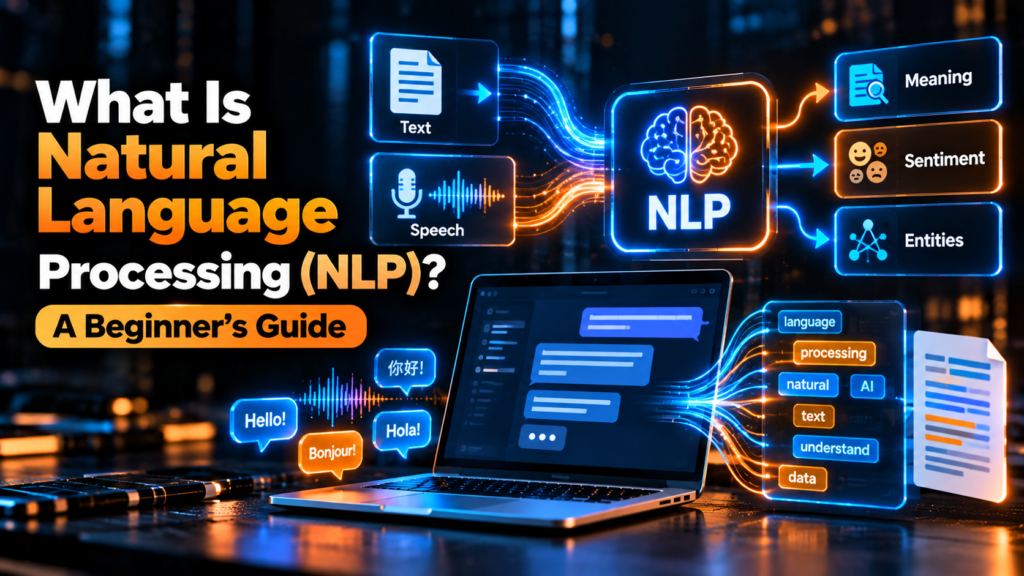
Every day, people write messages, search the web, ask questions, leave reviews, and speak to digital assistants. But how can a computer work with all that human language? One important area of artificial intelligence is natural language processing (NLP), the technology used to analyse, interpret, and generate language in text and speech.
NLP helps power features such as spam filtering, search, language translation, sentiment analysis, speech recognition, chatbots, and document analysis. It combines ideas from language science and computer science with techniques such as machine learning. The exact methods differ by application, and a result from an NLP system is not automatically correct.
In this beginner-friendly guide, you will learn what NLP means, how it works, common NLP tasks, real-world examples, benefits, limitations, and how it relates to modern generative AI.
For background, you can also read our guides to what artificial intelligence is, how AI works, and large language models (LLMs).
What Is Natural Language Processing (NLP)?
Natural language processing, or NLP, is a branch of AI that helps computers process and work with human language. “Natural language” means languages people use to communicate, such as English, Spanish, Hindi, Arabic, and many others. NLP systems can work with written text, spoken language converted to text, or audio in applications that combine language and speech technologies.
NLP is used to identify patterns in text, extract information, classify documents, estimate sentiment, translate between languages, and support conversational systems. Google Cloud describes NLP as a way to use machine learning to reveal the structure and meaning of text and derive insights from unstructured language data. See its Natural Language Processing overview.
NLP does not mean a computer understands language exactly as a human does. A system may recognise patterns or infer likely meaning without having human experience, intentions, or full awareness of the context. Its performance depends on the model, data, language, and task it was designed for.
How Does NLP Work?
NLP systems use different methods, so there is no single process that applies to every application. A common workflow involves collecting language input, preparing or representing it for a model, applying rules or a trained model, and returning a result for the application to use.
- Receive the input: A system gets a sentence, document, message, search query, or speech transcription.
- Prepare the language: Depending on the task, the system may split text into tokens, identify sentence boundaries, normalise text, or convert words into numerical representations.
- Analyse patterns and context: Rules, statistical methods, or machine-learning models process the input to detect useful patterns.
- Produce a result: The output might be a category, translated text, a sentiment label, extracted names, a summary, or a conversational response.
- Evaluate the result: Developers and users check whether the result is accurate and appropriate for the intended purpose.
Older NLP systems often relied heavily on hand-written linguistic rules and statistical techniques. Many modern applications use machine learning and deep learning, including transformer-based language models. The best approach depends on the problem: a simple rule or keyword search can be enough for some tasks, while more complex language work may require a trained model.
What Are the Main Tasks in NLP?
NLP is an umbrella term for many tasks. A single product may combine several of them.
1. Text Classification
Text classification assigns a label to a piece of text. Email spam filtering is a familiar example: a system estimates whether a message belongs in a spam category. Other examples include sorting support tickets by topic, routing feedback to a department, or categorising articles by subject.
2. Sentiment Analysis
Sentiment analysis estimates the opinion or emotional tone expressed in text. A business might analyse customer reviews to understand whether feedback is generally positive, negative, or mixed. However, sarcasm, slang, cultural context, and short messages can make sentiment difficult to classify reliably. A sentiment score should be treated as an estimate, not as a perfect reading of a person’s feelings.
3. Named-Entity Recognition (NER)
Named-entity recognition identifies and labels items such as people, organisations, places, dates, or other domain-specific entities in a passage. For example, an NLP application could extract a company name and a date from a business document to help organise records. Accuracy depends on the language, document quality, and types of entities the model has been designed to recognise.
4. Machine Translation
Machine translation converts text from one language into another. It can help people understand a message or prepare a first draft of a translation. For legal, medical, technical, or other high-stakes material, a qualified human should review important translations because a small wording difference can change the meaning.
5. Speech Recognition
Speech recognition converts spoken language into text. It is used in dictation, meeting transcription, voice interfaces, and subtitles. Results can be affected by background noise, accents, speaking speed, overlapping speakers, and specialised vocabulary. Speech recognition is closely related to NLP, although audio processing may involve additional technologies.
6. Summarisation
Text summarisation produces a shorter version of a document or conversation. It can help people review lengthy reports, meeting notes, or articles. A summary may omit important qualifications or introduce errors, so check the original source when accuracy matters.
7. Question Answering and Chatbots
Question-answering systems use language processing to respond to questions. Some follow structured rules or retrieve information from a knowledge base; others use large language models to generate answers. The system’s ability to answer correctly depends on the quality and relevance of its sources, its model, and any connected tools.
8. Information Extraction and Search
NLP can identify relevant details in documents and help search systems interpret the words in a query. Businesses may use it to extract dates, invoice numbers, names, or product references, or to search a large collection of text. Extraction results should be checked when they are used in records, financial processes, or decisions.
NLP Explained Visually
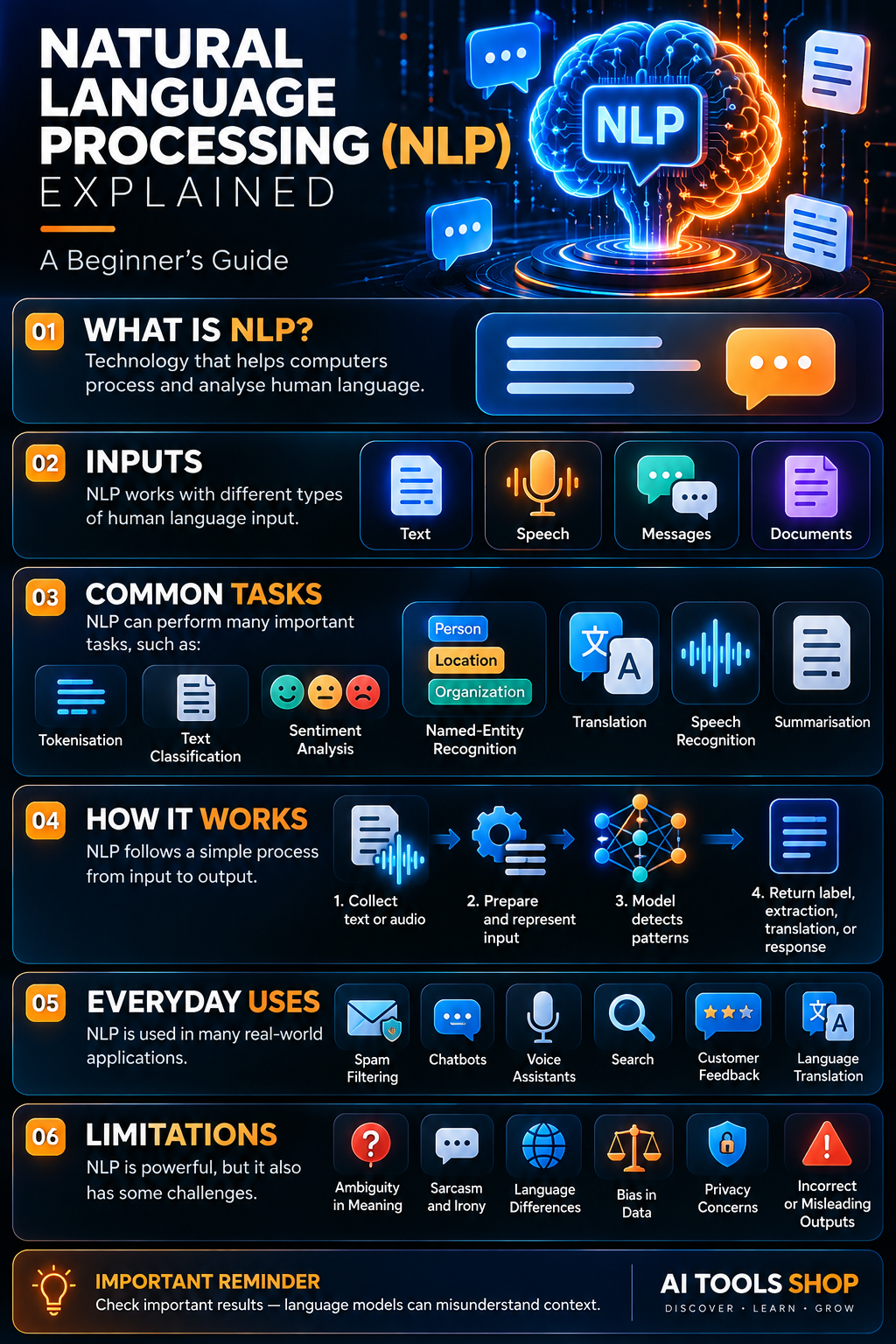
This infographic summarises what NLP does, the kinds of input it can handle, common tasks, a simplified workflow, and limitations to remember when interpreting the results.
Where Is NLP Used in Everyday Life?
You may already use NLP-powered features without noticing them. Examples include:
- Email and message filtering: identifying possible spam, unwanted messages, or suspicious content.
- Search engines: helping interpret queries and match them with relevant documents or answers.
- Customer support: answering common questions, routing enquiries, or summarising conversations.
- Voice assistants: turning speech into text and interpreting commands, often in combination with speech and other AI components.
- Translation tools: helping translate text across supported languages.
- Social media analysis: categorising posts and estimating themes or sentiment across large collections of messages.
- Document processing: finding names, dates, and key fields in forms, reports, and business documents.
- Writing assistants: suggesting rewrites, summaries, spelling corrections, and text drafts.
Google Cloud highlights applications such as sentiment analysis, entity analysis, document understanding, content classification, and trend spotting in its NLP guide. AWS also explains NLP tasks including part-of-speech tagging, word-sense disambiguation, speech recognition, sentiment analysis, and natural language generation in its NLP explainer.
What Is the Difference Between NLP, NLU, and NLG?
These related terms describe different aspects of language technology.
| Term | Plain-English meaning | Example |
|---|---|---|
| Natural Language Processing (NLP) | The broad field of working with human language using computers. | Classifying messages, extracting entities, or translating text. |
| Natural Language Understanding (NLU) | Methods focused on interpreting meaning, intent, or relevant context. | Recognising that “book a table for two” is a restaurant reservation request. |
| Natural Language Generation (NLG) | Methods that produce language output from data or instructions. | Generating a summary, response, or description. |
The terms sometimes overlap in practice, and definitions vary by source and context. In broad usage, NLU and NLG are often treated as areas within NLP: one focuses on interpreting language and the other on producing it. Modern applications can combine both in a single workflow.
How Is NLP Related to Machine Learning and Generative AI?
NLP is an application area, while machine learning is a set of methods often used to build NLP systems. A language-processing task may use rules, conventional machine learning, deep neural networks, or a combination.
Generative AI can be used for language generation, summarisation, rewriting, and conversational responses. Large language models (LLMs) are one important technology behind many modern generative language tools. But NLP is broader than LLMs: spam filtering, entity extraction, and other language tasks can use specialised models or simpler techniques.
Continue with our related guides: AI vs machine learning vs deep learning, what generative AI is, and what a large language model is.
What Are the Benefits of NLP?
- Scale: it can help process large volumes of text more quickly than reading every item manually.
- Consistency: a well-tested model or rules-based workflow can apply the same classification process repeatedly.
- Search and discovery: it can help find patterns, entities, and themes hidden in unstructured text.
- Accessibility: speech recognition and language tools can support transcription, translation, and alternative ways to interact with technology.
- Automation: it can reduce repetitive steps in document handling, customer support, and content workflows.
These benefits depend on the task, data quality, implementation, and evaluation. Automated processing can save effort, but reviewing exceptions and correcting mistakes may still require human time and expertise.
What Are the Limitations of NLP?
Human language is complicated. Words can have several meanings, people use irony and sarcasm, and the same phrase can mean different things depending on context. NLP systems can struggle with these variations, particularly when a language, dialect, or subject is underrepresented in training data.
- Ambiguity: a word or sentence may have multiple meanings.
- Context: the intended meaning may depend on earlier conversation, cultural knowledge, or information outside the text.
- Language coverage: performance may vary across languages, dialects, writing styles, and code-switching.
- Bias: models can reflect imbalances or stereotypes in data and design choices.
- Errors: extraction, translation, classification, or summarisation can be incorrect or incomplete.
- Privacy: text may contain personal or confidential information, so data handling and access controls matter.
For important tasks, check the results against the original material, test the system on representative examples, and provide a way to correct errors. Avoid treating an NLP label or generated summary as the final word when people’s rights, safety, finances, or health may be affected.
How Can Beginners Learn NLP?
You do not need to start by training a complex model. A useful learning path is to understand what NLP does, explore a few everyday applications, and then move to technical concepts if you want to build your own projects.
- Learn the vocabulary: understand tokens, classification, sentiment analysis, entities, translation, and summarisation.
- Try real examples: compare a few reviews, classify simple feedback, or summarise a short non-sensitive text.
- Practise with prompts: ask an AI tool to explain NLP concepts, but verify factual claims against trustworthy references.
- Learn basic Python if you want to code: practise reading text files, cleaning input, and evaluating simple outputs.
- Study evaluation: test how often a model makes correct predictions, which cases it misses, and whether errors affect groups differently.
- Protect data: use public or synthetic examples when learning and avoid uploading confidential text to a tool without checking its policies.
If you’re looking for practical tools to experiment with, see our guides to AI tools for beginners and free AI writing tools.
Frequently Asked Questions About NLP
What does NLP stand for?
NLP stands for Natural Language Processing. It is the field of AI concerned with processing and working with human language in text or related speech applications.
Is NLP a type of artificial intelligence?
Yes. NLP is commonly described as a branch or application area of AI. Many modern NLP systems use machine learning, although some language-processing tasks can use rules or other techniques.
What is an example of NLP?
Spam filtering, sentiment analysis, machine translation, speech-to-text, named-entity recognition, text summarisation, and language-based chatbots are examples of applications that can use NLP.
Do chatbots use NLP?
Many chatbots use NLP or related language models to interpret messages and generate responses. A chatbot may also combine rules, retrieval, APIs, and other components. Not every bot uses the same technology.
What is the difference between NLP and NLU?
NLP is the broader field of computer-based language processing. Natural Language Understanding (NLU) usually refers more specifically to interpreting meaning, intent, or context within language.
Can NLP understand sarcasm?
Some systems can identify patterns associated with sarcasm, but the task is difficult because meaning depends on context, culture, tone, and shared knowledge. Results should be evaluated rather than assumed correct.
Is NLP the same as generative AI?
No. NLP covers many language tasks, including classification and entity extraction. Generative AI creates new outputs; it can be used for language generation, but it is only one part of the broader NLP landscape.
Final Thoughts
Natural language processing helps computers work with human language, from classifying an email to translating a sentence or summarising a report. It brings together language knowledge, computer science, and—in many modern applications—machine learning. NLP tools can make information easier to search and process, but they can also miss context, make mistakes, or reflect bias.
Use NLP as a practical assistant, not an unquestionable authority. Check important results, protect sensitive information, and choose a method that fits the task. For more beginner-friendly learning, continue reading AI Tools Shop’s guides to AI fundamentals, how AI works, and large language models.
Official Sources and Further Reading
- Google Cloud: What is Natural Language Processing?
- AWS: What is NLP?
- Google for Developers: Machine Learning Glossary
Editorial note: NLP techniques and performance vary by language, task, and product. This guide introduces general concepts and does not claim that a specific NLP system was independently tested.