

Deep learning is a type of machine learning that uses neural networks with multiple layers to learn patterns from data. It helps power applications such as image recognition, speech-to-text, language translation, recommendation systems, and generative AI. You may already use it when your phone recognises speech, a photo app identifies objects, or an AI assistant generates a response.
In simple terms, deep learning gives a computer model many layers of connected processing units so it can learn useful patterns from examples. During training, the model adjusts internal values to reduce errors on a chosen task. After training, it can apply the patterns it learned to new inputs—but it can still make mistakes, especially when the new data differs from its training examples.
This beginner-friendly guide explains what deep learning means, how it works without complicated maths, examples you already use, how it differs from traditional machine learning, and the benefits and limitations to understand before relying on it.
For related background, read our guides to neural networks, machine learning, and AI vs. machine learning vs. deep learning.
What is deep learning in simple words?
Deep learning is a branch of machine learning that trains artificial neural networks with multiple layers. Instead of requiring a person to manually describe every pattern the system should recognise, a deep-learning model can learn useful representations from training data. For example, a model trained on labelled images may learn visual patterns that help it distinguish cats from dogs.
Google Cloud defines deep learning as a type of machine learning that uses artificial neural networks to learn from data. These networks contain layers of interconnected computational units, and training adjusts their weights to improve task performance. Read the Google Cloud deep learning overview for further details.
The word “deep” refers to the multiple layers in the network. Those layers can learn and combine patterns at different levels, depending on the architecture and task. This does not mean the model thinks exactly like a person: neural networks are mathematical models inspired in part by biological neural systems, not replicas of the human brain.
How does deep learning work?
A deep-learning system typically needs training data, a neural-network architecture, a learning objective, and a way to evaluate its performance. Here is a simplified sequence:
- Collect examples: gather suitable data, such as images, audio clips, text, or numerical records. Data quality and coverage matter.
- Prepare the input: convert the examples into a format the model can process. For an image task, this might include resizing images and representing pixel values numerically.
- Pass data through layers: the network transforms the input through connected layers. Different layers can learn different useful patterns.
- Compare the result with the target: during training, a loss function measures how far a prediction is from the desired result for the training example.
- Adjust the model: a training algorithm updates the network’s weights to reduce the loss, repeating the process over many examples.
- Evaluate on new data: developers test the trained model on separate examples to see how well it generalises beyond the data it learned from.
This is a high-level description, not a claim that every deep-learning system follows exactly the same process. The training method depends on the task. Some models learn from labelled examples; others use self-supervised, unsupervised, reinforcement-learning, or combined methods. Google for Developers explains core ideas such as nodes, hidden layers, activation functions, and training in its neural networks learning module.
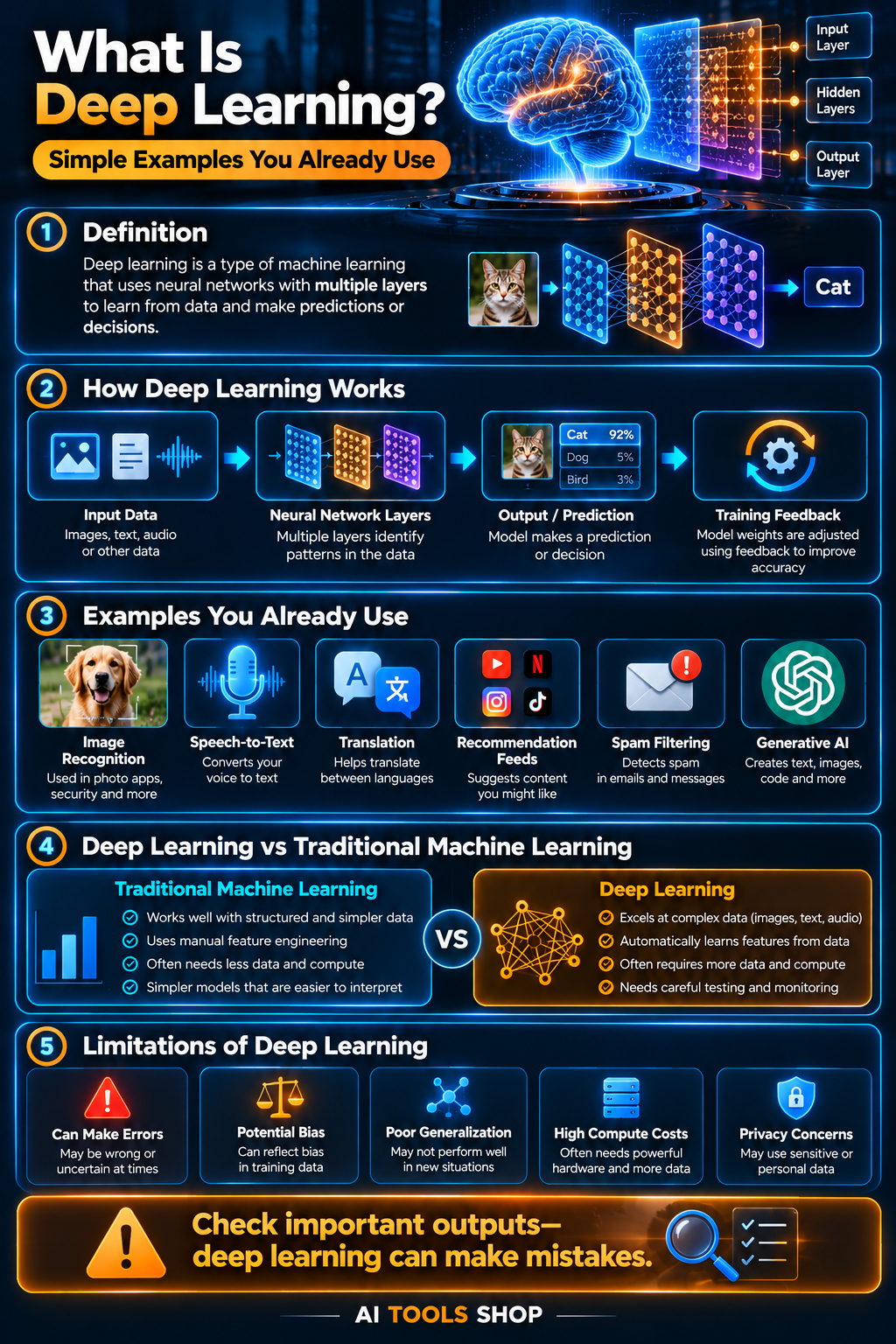
Deep learning explained visually
The infographic below summarises how layered neural networks process inputs, learn patterns, produce predictions, and are evaluated. It also highlights examples and common limitations.
What are everyday examples of deep learning?
Deep learning is often built into products, so users may interact with it without seeing the underlying model. These examples describe common application areas; the method used by a particular product may differ.
1. Face and object recognition in photos
Photo apps can use deep-learning models to detect faces, identify objects, group similar images, or help search a photo library. The model learns visual patterns from training examples. Errors can occur when images are blurry, lighting is poor, or the people and objects differ from training data.
Computer vision covers many of these tasks. Learn more in our guide to what computer vision is and how AI understands images.
2. Voice recognition and speech-to-text
Voice assistants, dictation tools, meeting transcription, and voice search can use deep-learning models to turn audio into text or help interpret spoken commands. Background noise, accents, overlapping speakers, and specialist vocabulary can affect accuracy. Important transcripts should be reviewed.
3. Translation and language tools
Deep-learning models can help translate sentences, classify text, summarise documents, and generate language. A translation may sound fluent while missing an idiom or a key detail, so human review is useful for specialised or high-stakes material. Our guide to natural language processing (NLP) explains these language tasks.
4. Recommendations on streaming and shopping platforms
Recommendation systems can use patterns in user activity, content information, and other signals to suggest videos, music, products, or articles. Deep learning is one possible technique in a recommendation system, but products may combine several model types, ranking rules, and business logic. A recommendation should not be assumed to reflect every user’s preferences equally.
5. Spam detection and fraud signals
Some email filters and fraud-monitoring systems use neural networks to identify patterns associated with unwanted or suspicious activity. These predictions are signals for a decision process, not proof that a message or transaction is harmful. Systems need to balance missed cases against false alarms.
6. Generative AI tools
Many modern systems that generate text, images, audio, video, or code use deep-learning architectures. Large language models, for example, use deep neural networks to process context and generate language. Image generators also commonly use deep-learning models, though their architectures and generation methods vary.
Read more about what generative AI is and how large language models work.
7. Medical-image analysis and scientific research
Deep-learning models can help analyse medical images, microscopy, satellite imagery, and scientific datasets. In healthcare, such outputs require appropriate validation and oversight by qualified professionals; an AI prediction is not a standalone medical diagnosis. Performance must be evaluated in the setting where the model will be used.
What is the difference between deep learning and machine learning?
Machine learning is the broader field; deep learning is one approach within it. Many traditional machine-learning methods work with structured data and may depend on manually designed features. Deep-learning models use multi-layer neural networks to learn representations from data and can be particularly useful for complex inputs such as images, audio, and language.
| Aspect | Traditional machine-learning methods | Deep learning |
|---|---|---|
| Relationship | Broad collection of approaches within machine learning. | A subset of machine learning using multi-layer neural networks. |
| Feature handling | May rely more on manually selected or engineered features, depending on the method. | Can learn useful features and representations from data. |
| Data types | Often effective for structured tables and defined features; capabilities vary by method. | Often strong for complex data such as images, audio, and language. |
| Data and computing | Some models work well with smaller datasets and fewer resources. | Large models may require substantial data, processing, and compute resources. |
| Interpretability | Some simpler models are easier to inspect and explain. | Large multi-layer networks can be more difficult to interpret. |
| Example | A decision tree predicting a category from structured customer data. | A neural network identifying objects in images or processing speech. |
These are tendencies rather than absolute rules. Some conventional machine-learning models are complex, and some deep-learning tasks can work with carefully prepared smaller datasets. The right choice depends on the data, goal, performance requirements, resources, and need to explain the output.
What are common types of deep-learning models?
Different neural-network architectures are designed to work with different patterns and kinds of data. These are some well-known families; the categories overlap and new architectures continue to develop.
- Convolutional neural networks (CNNs): often used in image and visual recognition tasks because they can learn spatial patterns.
- Recurrent neural networks (RNNs): designed to process sequences, with information from earlier steps influencing later steps. They have been used for language and time-series tasks, although newer approaches are widely used in many applications.
- Transformers: use attention mechanisms to model relationships among parts of an input. They are important in many language models and are also used in vision and other domains.
- Autoencoders: learn representations that can encode and reconstruct data, with applications such as compression and feature learning.
- Diffusion models: learn a process for generating data by iteratively transforming noise toward a structured sample; they are commonly used in image generation and other generative tasks.
You do not need to memorise these architectures to understand the basics. The key idea is that deep learning uses layers of learned computations, and different network designs suit different tasks.
What are the advantages of deep learning?
- Pattern recognition: deep networks can learn complex relationships in visual, audio, language, and other data.
- Automatic feature learning: the model can learn useful internal representations instead of relying entirely on hand-crafted features.
- Flexible applications: related deep-learning approaches are used across computer vision, language processing, speech, and generation.
- Continued improvement through training: performance can improve when data, objectives, training, and evaluation are designed well.
These advantages are not automatic. Results depend on data quality, model architecture, training, evaluation, and the conditions in which the system is deployed.
What are the limitations of deep learning?
Deep learning can be powerful, but it also has practical limitations. A model may perform well in one setting and poorly in another, and it may be difficult to explain exactly why it produced a particular result.
- Data requirements: some tasks need large, representative datasets, and collecting reliable labels can be costly.
- Compute and energy costs: training and running large neural networks can require specialised hardware and substantial resources.
- Overfitting: a model can learn training examples too closely and fail to generalise to unseen data.
- Bias: patterns in training data and design decisions can lead to uneven performance or unfair outcomes.
- Limited explainability: complex networks can be hard to interpret, which matters in high-impact settings.
- Errors and uncertainty: a prediction can be wrong or overconfident, so important outputs require verification.
- Privacy and security: training and inference workflows may involve sensitive data and need appropriate safeguards.
For high-impact applications, evaluate performance on representative examples, test failure cases, monitor behaviour after deployment, and include human review where needed. Do not treat a model’s output as guaranteed truth.
Can beginners learn deep learning without advanced maths?
Yes. You can understand the main ideas without starting with calculus or matrix algebra. Begin with the concept of inputs flowing through layers, a model producing a prediction, and training adjusting its parameters based on errors. If you later want to build models, learn Python, basic statistics, data preparation, and the foundations of machine learning.
- Start with the concepts: learn what a neural network, layer, weight, prediction, and training example are.
- Explore everyday examples: compare image recognition, speech-to-text, recommendation systems, and language models.
- Learn machine-learning basics: understand training versus testing data, loss, and overfitting.
- Try a beginner course: Google for Developers offers a Machine Learning Crash Course with modules on neural networks and related fundamentals.
- Build a small project: try a simple image or text classification exercise with a tutorial before attempting to train a large model.
- Evaluate carefully: test on examples the model did not train on and record mistakes, not just successful demonstrations.
Frequently asked questions about deep learning
What is deep learning in one sentence?
Deep learning is a type of machine learning that uses neural networks with multiple layers to learn patterns from data and produce predictions or other outputs.
Is deep learning the same as AI?
No. AI is the broad field, machine learning is one approach within AI, and deep learning is a subset of machine learning that uses multi-layer neural networks.
What is an everyday example of deep learning?
Examples include image recognition in photo apps, speech-to-text, language translation, some recommendation systems, and many generative AI tools. The exact technology varies by product.
Does deep learning copy the human brain?
No. Artificial neural networks are loosely inspired by biological neurons, but they are mathematical and computational systems. They are not exact replicas of the human brain, and their learning processes differ from human learning.
Does deep learning always need a lot of data?
Many deep-learning systems benefit from large datasets, but the amount required varies by task, architecture, pretraining, and fine-tuning approach. Some tasks can use pretrained models or smaller targeted datasets, though evaluation remains important.
Why does deep learning require powerful computers?
Training multi-layer neural networks can involve many numerical operations across large datasets and repeated parameter updates. Larger models and datasets can increase compute requirements, although hardware, model design, and efficiency techniques influence the actual cost.
Can deep learning make mistakes?
Yes. Models may misclassify images, misunderstand speech, generate incorrect language, or fail when data differs from training conditions. Verify consequential results and involve qualified people when the risk is high.
Final thoughts
Deep learning is a type of machine learning that uses neural networks with multiple layers to learn patterns from data. It contributes to many familiar technologies, including image and speech recognition, translation, recommendations, and generative AI. Its flexibility makes it useful for complex data, but it can also require substantial computing resources and produce mistakes or biased results.
The best way to understand deep learning is to connect the idea to real examples, learn how training and evaluation work, and remember that success on a demonstration does not guarantee reliability everywhere. Continue exploring AI Tools Shop’s guides to neural networks, machine learning, computer vision, and large language models.
Official sources and further reading
- Google Cloud: What is deep learning?
- IBM: What is deep learning?
- Google for Developers: Neural networks
- Google for Developers: Machine Learning Crash Course
Editorial note: This is a beginner overview of deep-learning concepts. Model capabilities, architectures, and performance vary by task and implementation. No independent product benchmark or hands-on performance test is claimed.