
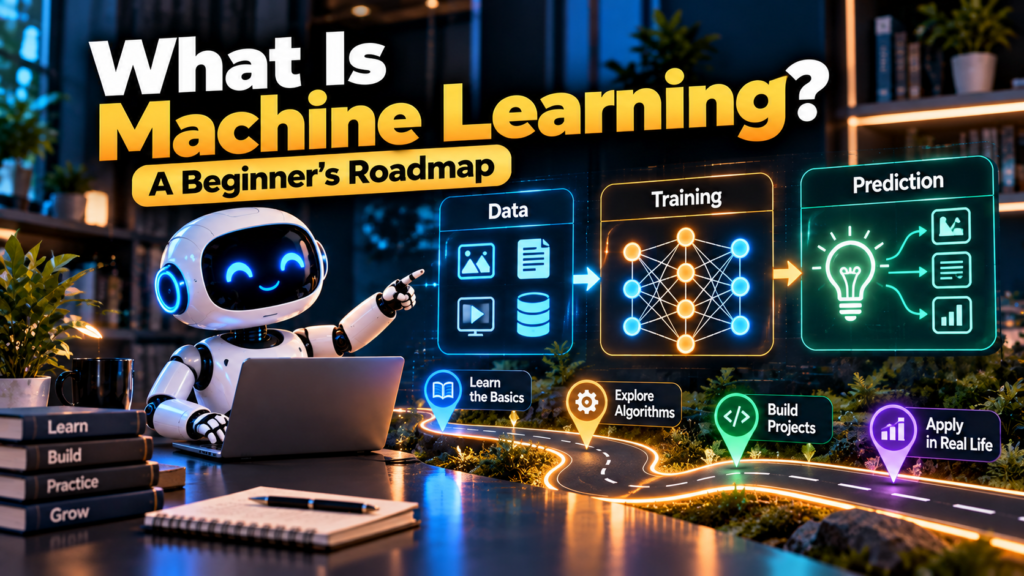
Machine learning (ML) is a branch of artificial intelligence that trains computer models to learn patterns from data and use those patterns to make predictions, classifications, recommendations, or generated outputs. Instead of writing a separate rule for every possible situation, developers train and evaluate a model using examples relevant to the task.
Machine learning is used in applications such as spam filtering, product recommendations, demand forecasting, speech recognition, image analysis, fraud detection, and generative AI. It can be useful, but its predictions are not automatically correct: results depend on the data, the model, the task, and how well performance is tested.
This beginner’s roadmap explains what machine learning is, how it works, the main learning approaches, everyday examples, common pitfalls, and the steps you can take to start learning it without getting lost in advanced mathematics.
If you are new to AI, start with our guides to artificial intelligence, how AI works, and AI vs. machine learning vs. deep learning.
Table of Contents
What Is Machine Learning?
Machine learning is a way to train software, called a model, to learn patterns from data and then use those patterns to produce an output. The output might be a predicted number, a category, a recommendation, or newly generated content, depending on the method and application.
Imagine you want to sort email into “spam” and “not spam.” Rather than manually writing a rule for every possible email, you can train a model on many examples that have already been labelled. The model learns statistical patterns in those examples, then estimates which label best fits a new message. It can make mistakes, so it must be evaluated on data it did not train on.
Google for Developers describes machine learning as training software models to make predictions or generate content using data. Its introductory course explains core concepts such as supervised learning, unsupervised learning, and evaluating model behaviour. See Google’s “What Is Machine Learning?” guide.
Machine learning is part of the broader field of artificial intelligence. Not every AI system uses machine learning: some systems rely on explicit rules, search, or planning. For a wider explanation, see What Is Artificial Intelligence?.
How Does Machine Learning Work?
A machine learning project usually follows a cycle: define the problem, collect and prepare relevant data, choose a method, train the model, evaluate it on appropriate data, and deploy and monitor it if it is suitable for use.
- Define the problem: Decide what you want to predict, classify, recommend, or generate and how you will judge success.
- Collect relevant data: Gather examples that represent the task. Check that you have the right to use the data and that it is suitable for the purpose.
- Prepare the data: Correct errors, handle missing values, remove duplicates where appropriate, and transform information into a usable format.
- Choose a model and train it: Use a learning approach suited to the problem and let the model fit patterns from the training data.
- Evaluate on unseen data: Test how well the model generalises to examples it did not see during training. Choose metrics that match the real task.
- Deploy and monitor: If evaluation is satisfactory, integrate the model into the workflow and monitor performance as data and conditions change.
For example, a retailer might use historical sales data to estimate future demand. The team defines what “demand” and the forecast period mean, prepares past sales and relevant input features, trains a model, checks forecast errors on later periods, and monitors whether the model remains useful. A model that performs well on old data may still struggle when prices, customer behaviour, or supply conditions change.
What Are the Main Types of Machine Learning?
The three common learning approaches beginners should understand first are supervised learning, unsupervised learning, and reinforcement learning. Generative AI is also an important application area and can use machine-learning techniques, but it is not simply a fourth method that always sits alongside the other three in the same taxonomy.
1. Supervised learning: learn from labelled examples
Supervised learning uses examples that include a target answer or label. The model learns a relationship between input features and the known output, then uses that relationship to make predictions for new examples.
- Classification: predict a category, such as whether a message is spam or not spam.
- Regression: predict a numerical value, such as a house price estimate or expected delivery time.
Supervised learning is useful when you have representative examples with dependable labels. If the labels are inaccurate or the training examples do not reflect real use, the model can learn misleading patterns.
2. Unsupervised learning: find patterns without supplied labels
Unsupervised learning works with data that does not include a target label for every example. The model attempts to identify structure or relationships, for example by clustering similar records together or reducing a dataset to a smaller set of useful dimensions.
A business might use clustering to explore groups of customers with similar purchase patterns. Those groups do not automatically reveal why customers behave as they do, and a human analyst must interpret whether the patterns are meaningful and useful.
3. Reinforcement learning: learn through actions and feedback
Reinforcement learning trains an agent to choose actions in an environment using feedback signals, often described as rewards or penalties. Over repeated interactions or simulations, the agent learns a strategy that aims to maximise a defined reward.
This approach can be used in robotics research, game-playing systems, simulation, and other sequential decision problems. Its results depend heavily on the design of the environment and reward: an agent may optimise the measured reward in ways that do not fully match the real-world goal.
Where does generative AI fit?
Generative AI creates outputs such as text, images, audio, video, or code by learning patterns in data. Many generative systems use deep-learning models. The term describes a category of AI applications and capabilities rather than one single training setup. Read our guide to what generative AI is and our beginner explainer on large language models (LLMs).
Machine Learning: A Visual Beginner’s Roadmap
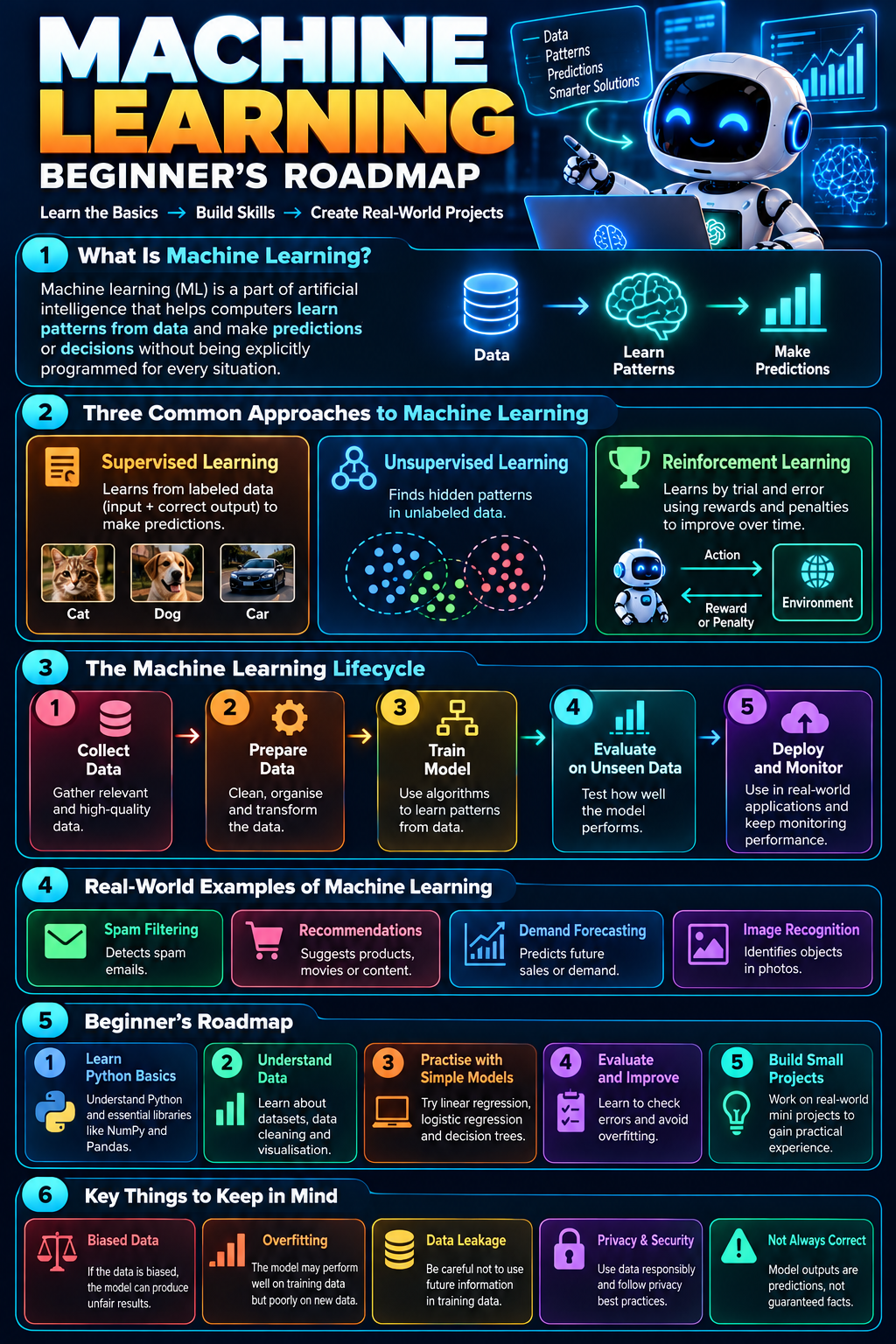
The infographic below summarises the basic model lifecycle, common learning approaches, example applications, and a practical path for beginners. It is a quick reference; the text in this article explains each concept in more detail.
What Are Real-World Examples of Machine Learning?
Machine learning is used across consumer products and business systems. These examples describe common applications; the exact implementation can vary between products.
| Application | What the model may do | What to check |
|---|---|---|
| Email spam filtering | Classify messages as likely spam or legitimate. | False positives, missed spam, and changes in spam tactics. |
| Product and media recommendations | Rank items a user may find relevant. | Relevance, feedback loops, privacy, and whether recommendations are useful or misleading. |
| Demand forecasting | Estimate future sales or resource needs from historical and contextual data. | Forecast error, changing conditions, and uncertainty ranges. |
| Fraud detection | Flag transactions or patterns for further review. | False alarms, missed cases, fairness, and how flagged cases are handled. |
| Image recognition | Classify images or locate objects in visual data. | Accuracy across lighting, devices, locations, and relevant user groups. |
| Speech and translation | Recognise spoken words or help translate language. | Accents, language coverage, ambiguity, and errors in high-stakes content. |
| Generative AI | Generate text, images, code, or other content from prompts and context. | Factual accuracy, bias, privacy, copyright, and the need for human review. |
Examples and use cases are described in Google Cloud’s machine learning overview. Whether an ML application is appropriate depends on the quality of the data, how the model is evaluated, and what happens when it makes an incorrect prediction.
What Is the Difference Between AI and Machine Learning?
Artificial intelligence is the broader field; machine learning is one approach within AI. AI also includes techniques that do not learn model parameters from data, such as some rule-based systems and planning methods. Deep learning is a subset of machine learning that uses neural networks with multiple layers.
| Term | Meaning | Example |
|---|---|---|
| Artificial intelligence (AI) | The broad field of building systems that perform tasks associated with perception, language, reasoning, or decision support. | A rule-based troubleshooting assistant or a learned image classifier. |
| Machine learning (ML) | A way to train models using data so they can identify patterns and produce outputs. | A spam filter trained on labelled emails. |
| Deep learning (DL) | A type of machine learning based on neural networks with multiple layers. | A neural network used for speech recognition or image analysis. |
For a fuller explanation, see AI vs. machine learning vs. deep learning and what a neural network is.
How Can Beginners Learn Machine Learning?
You do not need to master advanced mathematics before trying your first machine-learning project. A sensible roadmap is to learn the basic concepts, get comfortable with data, practise simple models, and gradually improve your evaluation skills.
- Learn the core vocabulary: understand datasets, features, labels, models, training, prediction, and evaluation.
- Learn basic Python if you want to build models: practise variables, functions, lists, data structures, and working with files.
- Learn how to work with data: understand rows and columns, missing values, duplicate records, visualisation, and basic statistics.
- Start with simple supervised models: explore a small classification or regression task and learn what the target variable represents.
- Learn evaluation before complexity: split data appropriately, choose suitable metrics, and compare performance with a simple baseline.
- Build small projects: use public, permitted datasets and write down the goal, assumptions, results, and limitations.
- Explore other methods: after the basics, try clustering, neural networks, or reinforcement learning based on your goals.
- Learn responsible practice: examine bias, privacy, security, and the consequences of incorrect predictions.
Google’s free Machine Learning Crash Course is a structured starting resource with practical exercises and explanations of core concepts. It is fine to explore the concepts first and return to the mathematical details as your projects become more advanced.
What Is a Good First Machine Learning Project?
A good first project is small enough to understand end to end and has a clear outcome you can evaluate. For example, classify a public dataset of short text messages, predict a numerical value from a small tabular dataset, or group records by similarity. Choose a dataset with clear documentation and permission for your intended use.
Use this beginner project checklist:
- Question: write down exactly what you want to predict or discover.
- Data: identify where the data came from, what each column means, and any limitations.
- Baseline: create a simple reference result before trying a more complex model.
- Split: separate training and test data correctly. For time-dependent data, avoid using future information to predict the past.
- Train: fit the model using training data only.
- Evaluate: use metrics suitable for the task and examine examples where the model fails.
- Explain: write down what works, what does not, and what you would improve next.
Do not start by trying to build a huge model from scratch. The goal of a first project is to understand the process—from problem definition and data preparation to evaluation—not to achieve a world-leading score.
What Mistakes Should Beginners Avoid?
- Using poor-quality data: incorrect labels, inconsistent formats, or unrepresentative examples can undermine results.
- Overfitting: a model may perform well on its training data but poorly on new examples.
- Data leakage: information unavailable at prediction time may accidentally enter training or evaluation, making results look unrealistically strong.
- Choosing the wrong metric: accuracy alone may be misleading when classes are imbalanced or different mistakes have different costs.
- Ignoring a baseline: without a simple comparison, it is hard to know whether a complex model adds value.
- Confusing correlation with causation: a pattern in data does not necessarily mean one variable caused another.
- Ignoring privacy and fairness: training or using models with sensitive or biased data can create harmful outcomes.
- Assuming predictions are facts: model outputs are estimates and should be interpreted in context.
What Are the Benefits and Limitations of Machine Learning?
Potential benefits
- Finds patterns in datasets too large or complex to review manually.
- Supports predictions, classification, ranking, and recommendations.
- Can automate repetitive tasks when performance is validated.
- Can improve as developers obtain better data, evaluation, and model methods.
Important limitations
- Results depend on data quality, relevance, and representation.
- Models can fail when real-world conditions differ from training conditions.
- Training and operation can require computing resources, expertise, and maintenance.
- Complex models may be difficult to explain, audit, or debug.
- Incorrect predictions and unfair outcomes may have real consequences.
Machine learning is most useful when there is a clear problem, relevant data, an appropriate evaluation method, and a plan for monitoring errors. It should not be used simply because AI is fashionable or because a complex model seems more impressive than a simpler solution.
Frequently Asked Questions About Machine Learning
What is machine learning in simple words?
Machine learning is a way to train computer models to learn patterns from data and use them to make predictions, classify information, recommend items, or generate outputs.
Is machine learning the same as artificial intelligence?
No. AI is the broader field, and machine learning is one approach within it. Some AI systems use explicit rules or planning without training a machine-learning model.
What are the three main types of machine learning?
The common introductory categories are supervised learning, unsupervised learning, and reinforcement learning. They differ in the feedback or information available during learning and the kind of problem being solved.
Do I need Python to learn machine learning?
You can learn the concepts without programming, but Python is commonly used for hands-on ML projects. Basic Python and data-handling skills are a practical starting point if your goal is to build models.
Do I need advanced mathematics to start?
No. You can begin with intuitive explanations and small projects. As you advance, basic statistics, algebra, probability, and later linear algebra or calculus can help you understand more of the underlying methods.
How long does it take to learn machine learning?
There is no fixed timeline. It depends on your programming background, study time, goals, and the depth of knowledge you want. Learning basic concepts and completing a small guided project is a more useful early milestone than chasing a universal deadline.
Is generative AI a type of machine learning?
Many generative AI systems use machine learning, especially deep learning, to learn patterns and generate content. Generative AI describes a capability and application area; the exact techniques differ by system.
Are machine-learning predictions always accurate?
No. Models make errors and can perform poorly on data unlike what they were trained on. Evaluate on suitable unseen data, monitor performance, and use human judgement when mistakes carry significant consequences.
Final Thoughts: Start Small and Learn by Testing
Machine learning allows software models to learn patterns from data and use them for predictions, classifications, recommendations, and generated content. Understanding the learning approaches, the training and evaluation process, and the limitations of data is more important for beginners than memorising algorithm names.
Start with a clear question, choose a small and well-documented dataset, establish a baseline, train a simple model, and evaluate it honestly. As your skills grow, explore more advanced models while continuing to pay attention to accuracy, fairness, privacy, and real-world consequences.
Continue learning with AI Tools Shop’s guides to AI fundamentals, neural networks, AI vs. ML vs. deep learning, and generative AI.
Official Sources and Further Reading
- Google for Developers: What Is Machine Learning?
- Google for Developers: Machine Learning Crash Course
- Google Cloud: What Is Machine Learning?
- Google for Developers: Machine Learning Glossary
Editorial note: This is an introductory learning guide. Machine-learning methods, evaluation requirements, and practical performance vary by task and dataset. No independent model benchmark or hands-on product test is claimed.