

Artificial general intelligence (AGI) is a proposed type of AI that could learn, reason, adapt, and solve problems across a broad range of tasks—not just perform well in a narrow set of predefined situations. Researchers, companies, and policymakers do not share one universally accepted definition or test for AGI, so there is no simple, agreed-upon point at which everyone would declare that it has arrived.
Will AGI ever happen? It is possible, but the timing and even the exact criteria remain uncertain. Progress in AI is real, yet impressive performance on selected benchmarks does not by itself prove that a system has general human-level ability across unfamiliar tasks, environments, and goals. The most useful approach is to define the capabilities being discussed, measure them carefully, and examine both benefits and risks.
This guide explains AGI in plain English, how it differs from current task-specific AI, what researchers debate, what would count as evidence of progress, and why predictions about its arrival should be treated cautiously.
For context, see our earlier guides to artificial intelligence, how AI works, AI vs. machine learning vs. deep learning, and agentic AI vs. chatbots.
What is AGI in simple words?
AGI stands for Artificial General Intelligence. It usually refers to a hypothetical AI system with broad abilities to learn, reason, and apply knowledge across many different intellectual tasks. Rather than being designed for only one particular job, an AGI system would be expected to handle a wide variety of familiar and new tasks, adapt to changing conditions, and transfer skills from one area to another.
Stanford’s Human-Centered AI glossary describes AGI as AI with general, human-level or beyond ability to learn, reason, and apply knowledge across a wide range of tasks and domains. The same definition notes that the term is controversial because people disagree about what “human-level” means and there is no universally accepted test. Read Stanford HAI’s explanation of AGI.
The details matter. One researcher might emphasise flexible learning and performance across cognitive tasks; another might emphasise autonomy, the ability to handle novel situations, or performance on economically valuable work. Those definitions overlap, but they are not identical. Any claim that AGI has been achieved should therefore state which definition and evidence it uses.
What is the difference between AGI and today’s AI?
Most AI tools people use today are developed and evaluated for specific tasks or sets of tasks. They can be powerful and versatile, but still show uneven performance: a system may be excellent at writing, coding, image recognition, or a benchmark while struggling with another seemingly simple task or with a new environment.
AGI is a proposed broader capability: handling many different tasks with robust generalisation, learning, and adaptation. It is not simply an AI chatbot that can hold a conversation, a model that scores highly on one exam, or software that can automate a particular workflow.
| Aspect | Task-specific or narrow AI | AGI (proposed concept) |
|---|---|---|
| Scope | Designed or optimised for defined tasks or a limited range of tasks. | Expected to learn and perform across a broad range of tasks and domains. |
| New situations | May struggle when conditions differ substantially from its training or design. | Would be expected to adapt to a wider variety of unfamiliar situations. |
| Transfer of skills | Transfer may be limited or uneven. | Broad transfer of learning and knowledge would be a central capability. |
| Evaluation | Can often be measured against task-specific benchmarks. | Requires broader evaluation across diverse tasks, conditions, and levels of autonomy. |
| Status | Existing systems are deployed for many defined tasks. | Definitions and evidence thresholds remain disputed; no universal test settles the question. |
This comparison is conceptual, not a claim that every current AI system is narrow in exactly the same way or that AGI must have one particular architecture. Some current systems can perform well across many domains. The unresolved question is whether their combined breadth, reliability, learning, and adaptability meet a defensible general-intelligence standard.
AGI explained visually
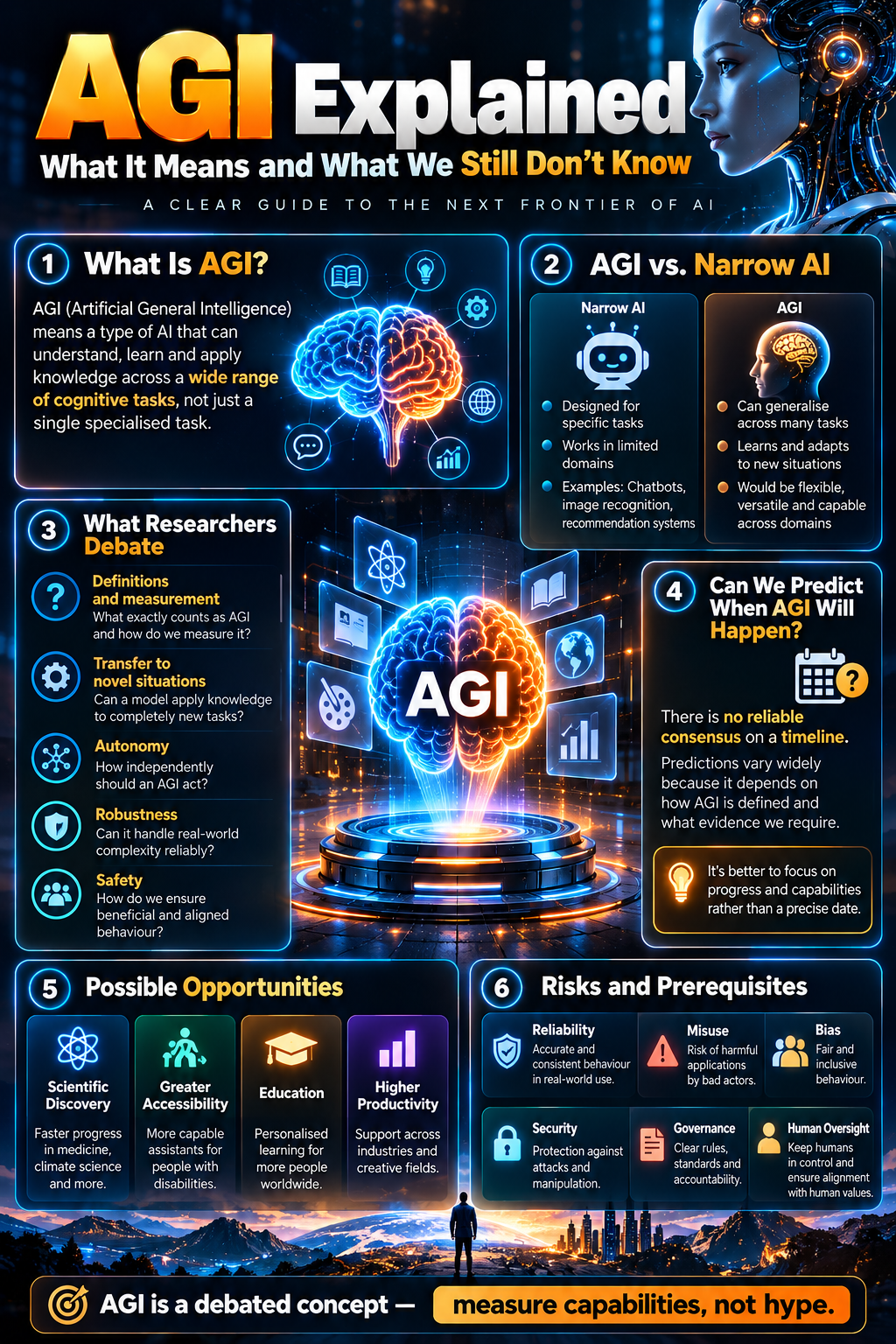
The infographic summarises the central questions: what AGI means, how it differs from narrow AI, why definitions and timelines are debated, and what opportunities and risks researchers consider.
What capabilities might AGI need?
There is no official checklist that all researchers agree must be satisfied. However, discussions of AGI often focus on several related capabilities. A useful evaluation would need to define each one clearly and test it with varied, independent examples rather than relying on a single demonstration.
1. Broad problem-solving
An AGI system would be expected to handle different kinds of intellectual tasks, potentially spanning language, mathematics, planning, science, and everyday problem-solving. The important question is not whether a system can answer one difficult question, but how broadly and reliably it can perform across task types.
2. Learning and adaptation
General intelligence involves handling situations that were not directly rehearsed during development. Researchers would want to know whether a system can learn new tasks, adapt to changed instructions, and use new information without requiring extensive rebuilding or retraining for each new problem.
3. Transfer of knowledge
Transfer means using knowledge or skills from one setting to help solve another problem. For example, a system might apply an idea learned in one technical domain to a related but unfamiliar task. Demonstrating genuine, robust transfer requires careful testing because apparent success may depend on familiar patterns or hidden clues in the test.
4. Reliability in unfamiliar conditions
High scores in standard conditions are not enough if performance collapses under small changes in wording, environment, or task requirements. A candidate system would need robust evaluation across unexpected inputs, edge cases, and situations where incorrect results carry different levels of risk.
5. Planning and appropriate autonomy
Some definitions place emphasis on systems that can plan and act with increasing independence. However, autonomy is not the same as intelligence: an agent can execute a sequence of actions without demonstrating broad general reasoning. Researchers need to evaluate both what a system can do and how safely it does it.
6. Generalisation beyond benchmarks
Benchmarks can help compare systems, but a benchmark can become less informative when models are trained on similar examples or when the task no longer distinguishes among capability levels. AGI assessment would need diverse tests, real-world evaluation, and transparent limits on what the results establish.
Google DeepMind’s research paper “Levels of AGI for Operationalizing Progress on the Path to AGI” proposes a framework that considers both breadth of capabilities and depth of performance, while also discussing autonomy, risk, and the difficulties of benchmarking. It is one framework, not a universal standard adopted by every researcher.
Is AGI the same as artificial superintelligence?
No. The terms are related but are often used to describe different levels or kinds of capability.
- Narrow AI: systems designed for particular tasks or a bounded range of applications.
- AGI: a proposed system with broad, general abilities across many intellectual tasks, often described in relation to human-level capability.
- Artificial superintelligence (ASI): a hypothetical system that would substantially exceed human abilities across a broad range of areas.
These labels do not form a universally agreed technical ladder with a single test at each stage. Different organisations define them differently, and labels such as “human-level” or “superintelligent” can hide important differences between tasks, reliability, autonomy, and the ability to learn.
Will AGI ever happen?
The honest answer is that nobody can reliably say for certain. AGI could be achievable, but the timeline depends on scientific progress, engineering, available computing, evaluation methods, and what definition of AGI is used. Some researchers and companies expect substantial progress; others emphasise unresolved limitations and uncertainty. There is no single expert consensus that establishes a specific arrival date.
Even OpenAI’s public charter says the timeline to AGI remains uncertain, while defining AGI for its own mission in terms of highly autonomous systems that outperform humans at most economically valuable work. That is the organisation’s stated definition, not a universally accepted one. See the OpenAI Charter.
The UK-led International Scientific Report on the Safety of Advanced AI notes that AGI has no universally precise definition and examines both potential capabilities and risks. This is why confident claims about an exact year should be treated as forecasts or opinions unless they are supported by a clear definition and evidence.
Why is it so difficult to predict when AGI could arrive?
Several challenges make forecasting difficult. They are not simply engineering problems with known completion dates; some concern what intelligence means and how researchers can measure it.
- No universal definition: different definitions produce different thresholds for success.
- Uneven capabilities: models can be strong in one area and unreliable in another.
- Benchmark limits: test scores may not capture all the skills needed for robust performance in unfamiliar conditions.
- Uncertain scientific progress: new techniques may produce rapid gains, while other problems may prove harder than expected.
- Deployment matters: broad capability is distinct from safe, reliable operation in real environments.
- Human comparison is complicated: human abilities vary, and “matching human performance” could mean average performance, expert performance, or performance across nearly every relevant task.
For these reasons, it is more meaningful to ask what capabilities a system has demonstrated, under which conditions, and with what error rate than to focus only on a predicted date.
Could today’s advanced AI already be AGI?
There is no universally accepted test that produces a definitive yes-or-no answer. Advanced AI systems can perform well on a wide range of language, coding, reasoning, and multimodal tasks, but their performance can still be uneven. Whether a system qualifies as AGI depends on the definition being used and the quality of evidence for broad, robust generalisation.
Stanford’s 2026 AI Index reports significant improvements on several frontier benchmarks and also highlights difficulties with evaluation as benchmarks saturate and independent testing does not always confirm reported performance. These trends show why progress should be measured carefully; benchmark performance alone does not settle the AGI question. See the 2026 AI Index Report.
A responsible assessment should ask: Does the system generalise to genuinely new tasks? How stable is its performance? Can independent evaluators reproduce the results? What kinds of failures remain? What autonomy does it have, and what safeguards are in place? Without answers to questions like these, the label can tell us less than a transparent capability report.
What might be the benefits of AGI?
If systems eventually achieved reliable, broad capabilities, possible benefits could include accelerating research, supporting education, helping people with disabilities, assisting scientific discovery, and making expertise more accessible. They might also help organisations solve complex planning and analysis problems.
These are potential outcomes, not guaranteed predictions. Benefits would depend on how systems are developed, who can access them, how their outputs are checked, and whether their use is aligned with human goals. A more capable system does not automatically distribute gains fairly or solve social problems on its own.
What are the risks and concerns around AGI?
Debates about AGI include both familiar AI risks and challenges that could become more serious as capabilities and autonomy increase. The importance of any risk depends on the system, the tasks it can perform, how it is connected to real-world tools, and the safeguards around it.
- Reliability and unexpected behaviour: a highly capable system could still make errors, misunderstand goals, or fail in unfamiliar situations.
- Misuse: advanced capabilities could be used for fraud, cyber abuse, manipulation, or other harmful purposes.
- Security: systems with powerful tool access may create new ways for attackers to exploit software or data.
- Concentration of power: if benefits and control are limited to a small number of organisations or governments, inequality and dependency could increase.
- Economic disruption: AI could change tasks, occupations, wages, and business structures, with impacts that are hard to predict in advance.
- Control and alignment: ensuring that a system pursues intended goals and respects constraints becomes more important as its capabilities and independence grow.
- Governance and accountability: societies need ways to test systems, assign responsibility, respond to incidents, and manage deployment decisions.
These risks should be discussed without assuming either that catastrophe is inevitable or that advanced systems will automatically be safe. Evaluation, independent testing, security, monitoring, governance, and meaningful human oversight can all play a role in managing risk. The international scientific report on advanced AI safety reviews potential benefits, risks, and mitigation approaches.
How should we measure progress toward AGI?
A useful evaluation should measure a portfolio of capabilities rather than rely on a single score. The goal is not merely to prove a headline claim, but to understand where a system performs well, where it fails, and how much confidence to place in the results.
- Test diverse tasks: include language, reasoning, planning, perception, learning, and other relevant abilities.
- Use unfamiliar examples: test generalisation beyond highly familiar or repeatedly used benchmark questions.
- Measure reliability: report failures, uncertainty, and variation—not only best results.
- Use independent evaluation: make methods transparent enough for external researchers to scrutinise where possible.
- Assess autonomy separately: distinguish solving a task when asked from acting independently across a long sequence of steps.
- Evaluate safety in context: consider misuse, security, human oversight, and potential consequences of errors.
This approach fits the spirit of Google DeepMind’s AGI levels framework, which argues for clearer language around capability levels and greater attention to the depth and breadth of performance.
Frequently asked questions about AGI
What does AGI stand for?
AGI stands for Artificial General Intelligence. It usually refers to a proposed AI system that can learn, reason, and apply knowledge across a broad range of tasks rather than being limited to a narrow set of functions.
Does AGI exist today?
There is no universally accepted definition or test that settles the question. Advanced systems perform well on many tasks, but whether any system meets a given AGI threshold depends on the criteria and evidence used. Claims should specify what has been tested and how.
Will AGI happen by 2030?
No reliable consensus establishes that AGI will arrive by 2030. Forecasts vary, and their meaning depends on the definition of AGI, assumptions about progress, and how capability is measured. A specific date should be treated as a prediction, not a fact.
What is the difference between AGI and AI?
AI is the broad field of building computer systems that perform tasks such as prediction, recognition, language processing, or decision support. AGI refers to a hypothetical form of AI with general capabilities across a wide variety of tasks.
What is the difference between AGI and ASI?
AGI usually refers to broad, human-level or comparable general capability. Artificial superintelligence (ASI) is a hypothetical concept referring to intelligence that substantially exceeds human ability across a wide range of domains. Definitions vary, and neither term has a universally agreed measurement threshold.
Is AGI the same as a large language model?
No. A large language model (LLM) is a model designed to process and generate language. An LLM may be part of a more capable AI system, but being a large language model does not by itself establish that the system has general intelligence across many domains.
Why do experts disagree about AGI?
They may use different definitions of generality, human-level performance, learning, autonomy, and reliability. They also disagree about how much current benchmark performance tells us about a system’s ability to handle new real-world tasks. Without shared definitions and tests, claims are difficult to compare.
Final thoughts: focus on evidence, not a countdown
AGI is a proposed form of AI with broad, adaptable capabilities across many tasks. It may be possible, but there is no universal definition, accepted test, or reliable consensus on when it could arrive. Current AI advances are important, yet the most informative way to judge progress is to look at generalisation, reliability, autonomy, evaluation quality, and safety—not just a product label or benchmark headline.
For readers learning about AI, the practical takeaway is to understand today’s systems on their demonstrated capabilities and limitations. Continue with our guides to AI fundamentals, large language models, agentic AI, and computer vision.
Official sources and further reading
- Stanford HAI: What is AGI?
- Google DeepMind: Levels of AGI for Operationalizing Progress on the Path to AGI
- OpenAI Charter: mission, AGI definition, and uncertainty around timelines
- Stanford HAI: 2026 AI Index Report
- International Scientific Report on the Safety of Advanced AI
- Google Cloud: What is artificial general intelligence?
Editorial note: AGI is a debated research concept. This article distinguishes common definitions from current evidence and does not claim that a particular system has achieved AGI or predict a definite arrival date.